An intercept is a learned additive parameter that shifts a model’s output independently of its inputs. In a weighted-sum model, y = w₀x₀ + w₁x₁ + b, the weights scale features while b shifts the result. Machine learning estimates the intercept together with the weights during training. section 1.1 section 1.3.4
Geometrically, the intercept moves the decision boundary through feature space. For the threat-score example, the separator x₀ + x₁ − 1 = 0 corresponds to an additive shift of −1 before interpreting the signed output. Changing the intercept therefore changes which inputs fall on each side of the boundary without changing feature slopes. section 1.4 section 1.3.6
Perceptron decision thresholds
A perceptron for logical AND uses weights 1 and 1 with bias −1.5, producing 1 only when x₀ + x₁ ≥ 1.5. A logical OR uses the same weights with bias −0.5, producing 1 whenever at least one input is 1. The different biases shift the decision boundary while leaving the weights unchanged. section 7.3.4
Figure 7.11 Geometrical views for the perceptrons in figure 7.10. Each dot represents an input point(a [x0 x1] vector). The shaded dots map to an output value of 1, and the unshaded dots map to an output value of 0. The thick line indicates the decision boundary.
|
(a) Logical AND decision boundary: x0 + x1 = 1.5 |
|
(b) Logical OR decision boundary: x0 + x1 = 0.5 |
|
(c) Logical NOT decision boundary: x0 = 0.5 |
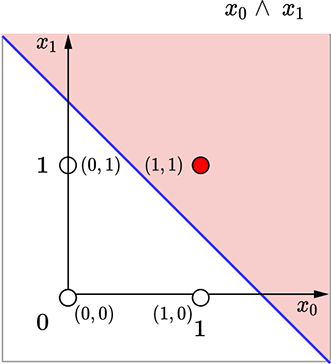
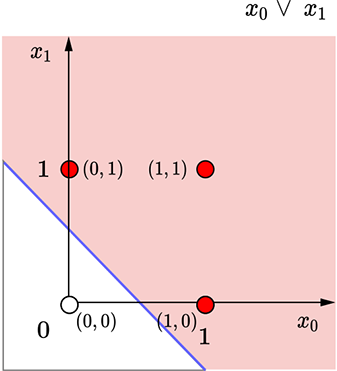
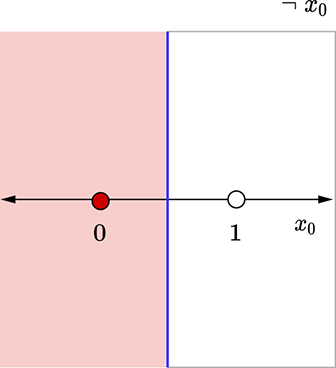
Use the decision-boundary table to compare how different bias values partition the binary input points. section 7.3.4
Key points:
- Adds a constant term that is not multiplied by an input. section 1.3.4
- Shifts model outputs and linear decision boundaries. section 1.4
- Joins the weights as a trainable parameter and is optimized by minimizing loss. section 8.4.1






