An intercept is the parameter that sets a model’s predicted response when its predictors are zero. In the line y = mx + b, b shifts the line up or down, while m controls its slope. section 3.10
The intercept appears in several related modeling settings:
- For house-price prediction, square footage is x and price is y; the intercept represents the model’s baseline prediction when x equals zero. section 3.10
- In a neural network, the bias term b accompanies the weights in each linear transformation, producing y = mx + b. section 10.1
- Linear-regression discussions may set b = 0 temporarily to simplify the mathematics, even though a full model usually includes it. section 3.10
A baseline prediction
Suppose a fitted line is y = mx + b. Setting x to zero leaves y = b, so the intercept is the line’s predicted response at that reference point. In a neural network, the same additive term is called a bias. section 3.10 section 10.1
Figure 10.2 The architecture of an example neural network with two hidden layers of size 6 and 4.
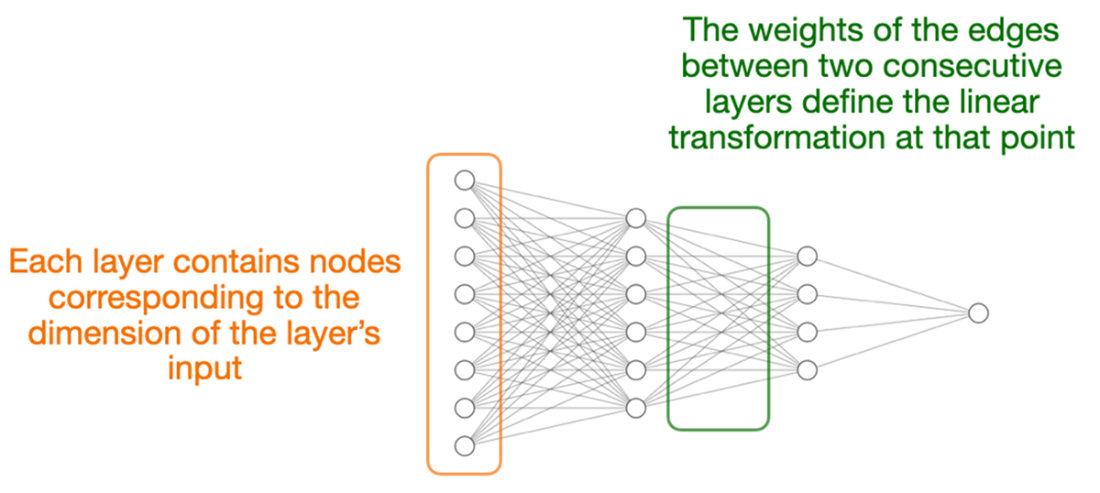
Use the network architecture figure to locate bias terms alongside weights across the model’s layers. section 10.1










