A binary outcome has only two possible results: 1 or 0, true or false, such as whether a toddler has a meltdown. section 8.2
Meltdown or no meltdown
Track hours since a toddler's nap alongside whether a meltdown occurred. The observations remain at 0 or 1: before roughly three hours, meltdowns are uncommon; after three hours, they become more likely. section 8.2
Because a straight line fits binary points poorly, logistic regression models the probability of the yes/no outcome with an S-shaped curve. A probability threshold, commonly 0.5, converts that estimate into a prediction. section 8.2
Figure 8.1 Data showing time without a nap and whether a toddler had a meltdown
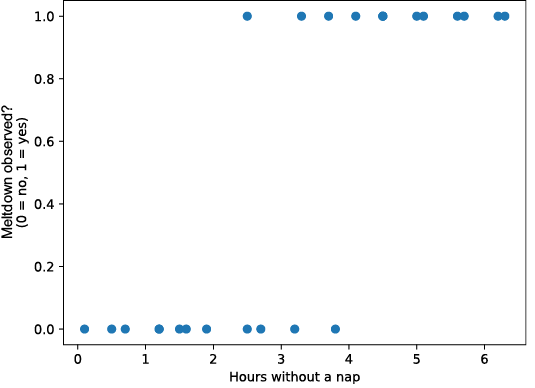
Inspect the binary observations linking time without a nap to meltdown occurrence. section 8.2
Figure 8.2 A logistic regression model of time without a nap and whether a toddler had a meltdown
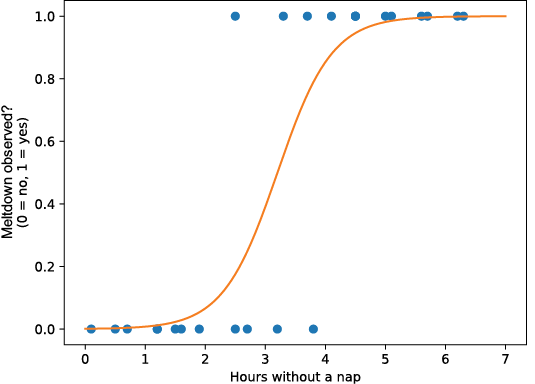
Follow the fitted S-curve as it turns binary observations into estimated meltdown probabilities. section 8.2



