Caching adds a storage layer for reusable data or computation results, reducing repeated retrieval and calculation. It improves performance only when its capacity, freshness, invalidation, and failure behavior remain controlled as usage grows. section 1.4 section 4.5.3
Design a cache around explicit operational safeguards:
- Cache only needed data rather than entire datasets, and keep memory usage bounded with size limits. section 4.5.3
- Set expiration policies so stale entries refresh even when explicit invalidation fails. section 4.5.3
- Invalidate derived data when its source changes, and define acceptable inconsistency windows before distributing the cache. section 4.5.3
- Check whether cache failure degrades gracefully or overloads the database, especially when preparing for tenfold growth. section 4.5.6
Dashboard filters and mobile thumbnails
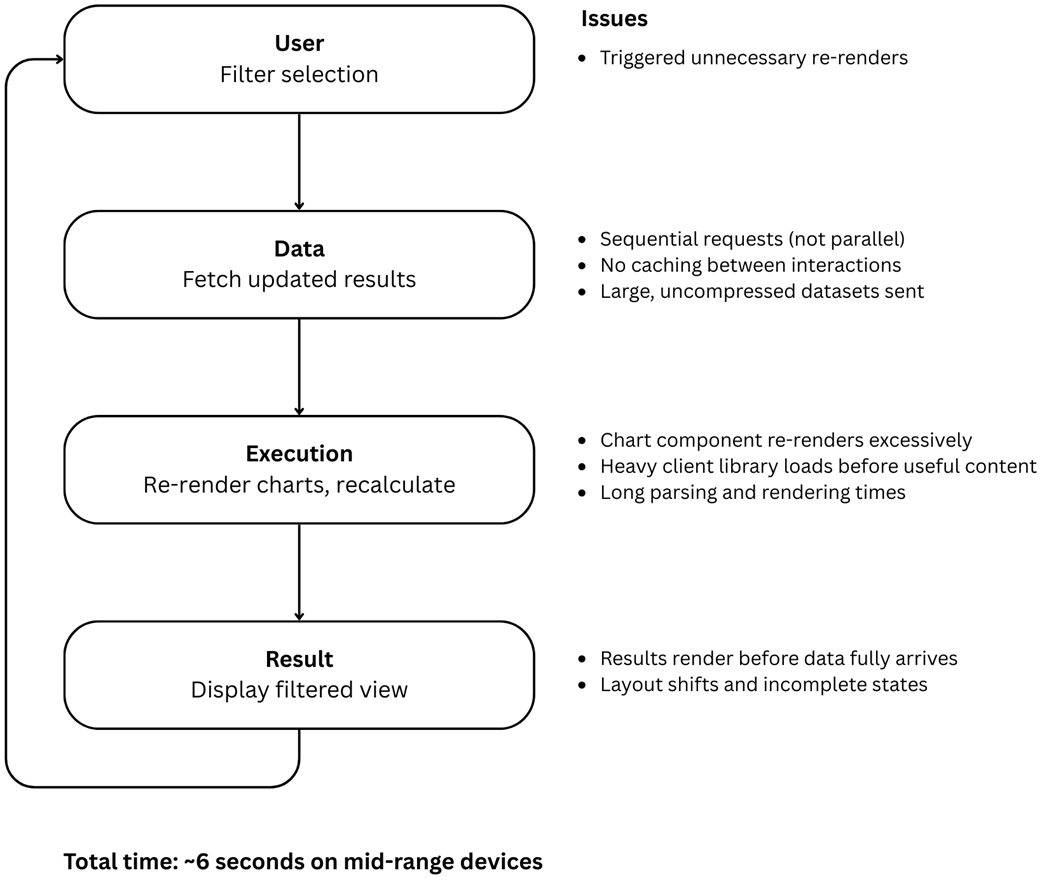
A slow dashboard fetched data sequentially, recomputed results between interactions, and re-rendered heavily. Caching repeated computation became one part of a broader fix. In a mobile app, moving image decoding off the main thread and caching pre-resized thumbnails eliminated scrolling hitches. section 1.4 section 7.3.2
Figure 1.5 The slow dashboard’s System Paths. Each stage has problems that add to the total delay: the User stage triggers unnecessary re-renders, the Data stage makes sequential requests without caching, the Execution stage re-renders excessively with heavy libraries, and the Result stage shows incomplete states before data arrives.
Trace caching through the dashboard’s Data path alongside sequential requests, execution work, and incomplete result states. section 1.4