A canary deployment sends a small, controlled share of live traffic to a new release before expanding it. Like miners’ canaries, the small group can reveal danger early: if the release causes problems, most users remain on the trusted version. section 13.3.3
Turn the traffic dial gradually
Send 2% of Order Service requests to version 2.0 and leave 98% on version 1.0. Watch errors and completed checkouts; if the canary stays healthy, increase its share to 10%, 25%, then 50%, and eventually the whole system. If it fails, remove the canary. section 13.3.3
The tradeoff is controlled exposure in exchange for more operational work:
- A small traffic share limits the blast radius and lets the release face real production behavior. section 13.3.3
- Old and new versions run concurrently, so routing must keep users on one version during a session. The setup also requires close monitoring and carries a larger dual-version footprint. section 13.3.3
- Watch for data divergence: canary instances writing a changed data layout can conflict with the legacy assumptions of the main fleet. section 13.3.3
- Choose canaries when containing the blast radius matters most, especially when microservices need validation under genuine load; expect greater instrumentation complexity. section 13.3.5
Figure 13.3 Canary Deployment: Routing a small, controlled slice of production traffic to new code allows you to validate system behavior before a full-scale rollout.
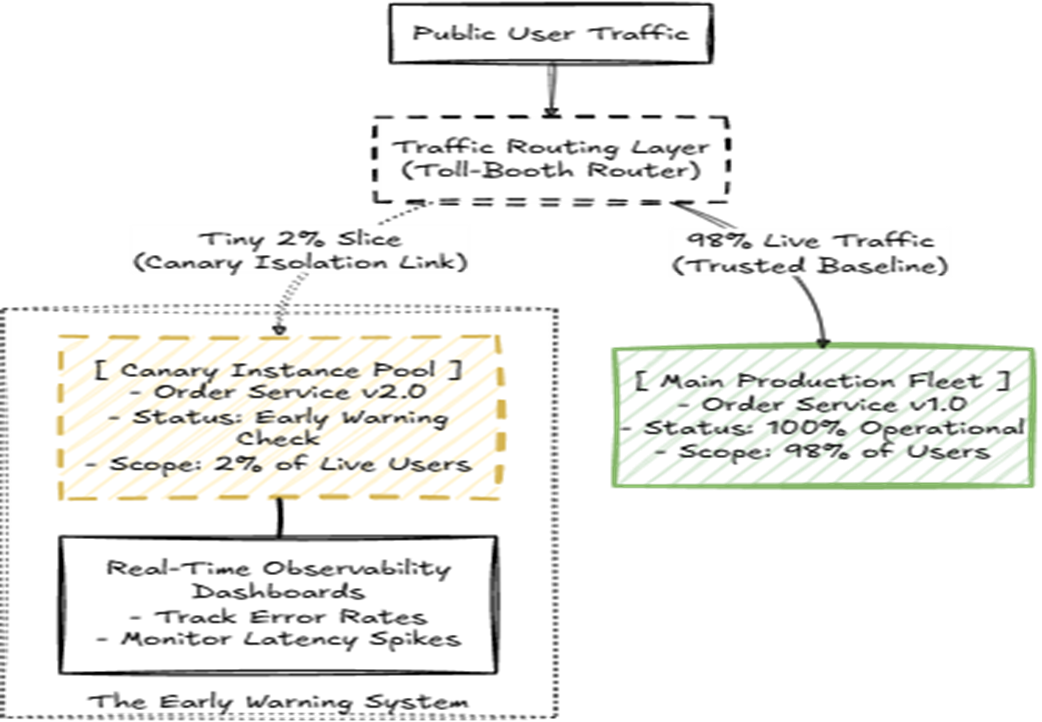
See how a small, controlled slice of production traffic reaches the new release before a full rollout. section 13.3.3










