Cloud computing provides computing resources over a network. For most users of large language models, cloud infrastructure supplies the computation needed to serve responses without running the models on local hardware. section 8.1.2
Users and applications typically reach hosted models through application programming interfaces (APIs), which abstract the underlying infrastructure. The same model may be available directly from its developer or through cloud providers that host and integrate it. Open-weight models offer another route: their parameters can be downloaded and run on self-managed infrastructure, giving users more control and responsibility. section 8.1.2
Figure 8.1 The large language model ecosystem. Models are built on a layered system that begins with specialized hardware and extends through cloud infrastructure and model providers. Interaction with this system occurs primarily through the two bottom layers, where users either consume models via managed services that abstract the underlying complexity or deploy open-weight models on self-managed infrastructure, taking on greater control and responsibility.
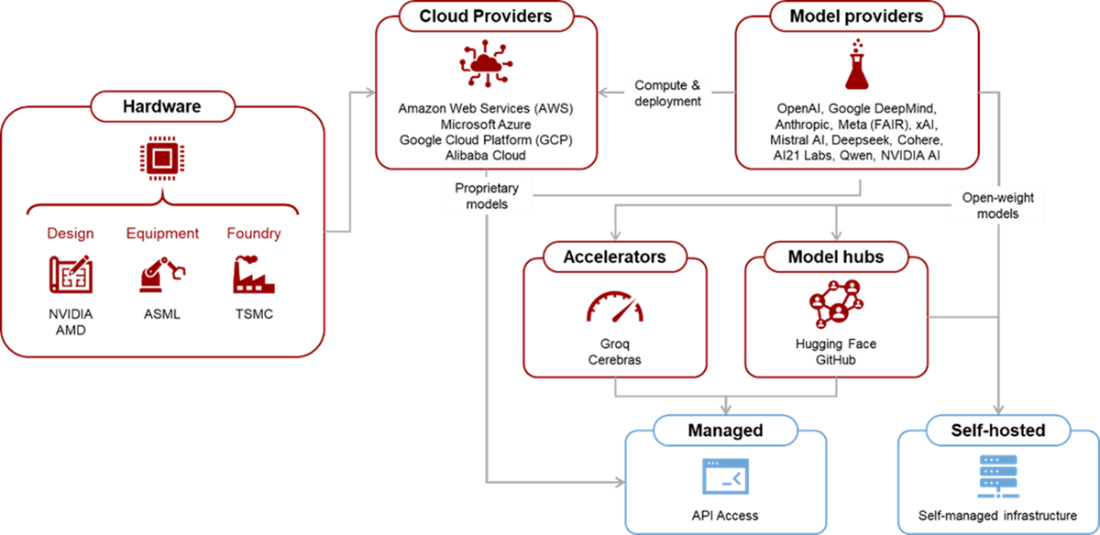
The layered ecosystem shows how cloud infrastructure connects specialized hardware and model providers to managed services and self-managed deployment. section 8.1.2
Remote access does not remove physical constraints. Cloud data centers depend on energy, cooling, space, and specialized chips. Demand for high-end compute can exceed available capacity, making access a strategic resource rather than a simple on-demand purchase. section 8.1.2 section 8.1.3
Cloud deployment also involves organizational and technical trade-offs. Partnerships can tie model development and deployment to particular platforms. Hardware, networking, and software optimized together may improve speed and cost, but can make workloads harder to move between systems without losing efficiency. section 8.1.3
Alternative compute capacity
Anthropic runs some workloads on TPUs through Google Cloud to access alternative compute capacity. Google also uses its own TPU infrastructure to train and serve models within an integrated environment. section 8.1.3