liveBook · Manning

Confidence

As explained in Deep Learning with R, Third Edition

A confidence score is a numerical estimate of how likely a predicted detection is to represent a valid object.

A confidence score is a numerical estimate of whether a predicted bounding box represents a valid object. YOLO makes it high when an object occupies a grid location and near zero when no object is present. section 12.2.2

Each grid detector predicts five box values: center position, width, height, and confidence. Training labels assign confidence 1 to an actual box and 0 elsewhere; YOLO also describes training confidence toward the predicted box’s intersection over union with ground truth. section 12.2.3 section 12.4

Filtering detections

A prediction routine reads the fifth value in each grid cell as confidence, converts the grid-relative box to image coordinates, and can omit predictions below a chosen cutoff.

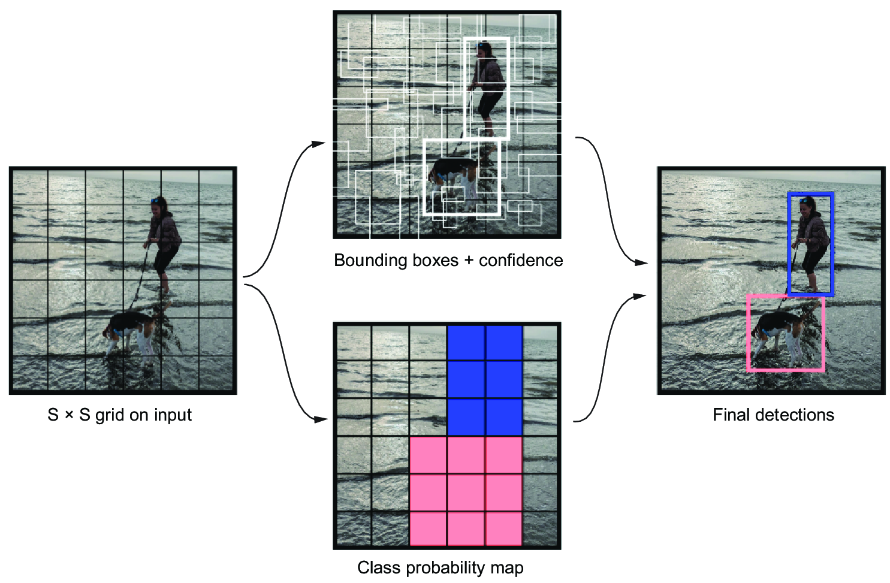
Figure 12.4 YOLO outputs as visualized in the first YOLO paper
figure

Visualizes YOLO’s grid-based outputs, including a confidence value associated with each predicted box. section 12.2.2


How Deep Learning with R, Third Edition covers it

How deep it goes
Explains confidence as a grid-cell output, training target, and prediction cutoff, but does not derive its loss mathematically.
Examples
Uses grid-cell targets, COCO image regions, drawn bounding boxes, and configurable confidence cutoffs as concrete examples.
What it assumes
Assumes familiarity with images and boxes while introducing grid-relative coordinates, detector outputs, and confidence targets alongside them.
What you can do after
Apply it via a prediction cutoff to suppress low-confidence detections during visualization or object-detection inference.
How it connects
Connects confidence with YOLO, object detection, bounding boxes, class probability maps, and intersection over union.

Also explained in

Compare how 13 books explain confidence →

Related concepts

This explainer was generated by Manning's knowledge graph from the text of Deep Learning with R, Third Edition. The section links point to the parts of the book it draws on.










