A confidence score is a scalar estimate of how strongly retrieved evidence supports an answer or prediction. In retrieval-augmented generation, a specialized evaluator scores document relevance before answer synthesis and uses the result to control the next operation. section 11.2.1
A retrieval system can turn the score into three operational zones:
- High confidence: treat the retrieved documents as relevant and proceed to knowledge refinement. section 11.2.1
- Low confidence: discard potentially misleading documents and trigger external web search. section 11.2.1
- Intermediate confidence: retain the internal documents while using web search to corroborate or supplement them. section 11.2.1
Confidence is an audit signal, not proof that the best evidence was retrieved. The evaluator sees only the returned set, so a stale or incomplete corpus can still receive a plausible verdict. Marginalized evidence offers a complementary signal: agreement across documents raises confidence, while scattered support lowers it. section 11.2.1 section 4.2.2
Compliance retrieval
When a high-risk entity search returns ambiguous results, a confidence-aware system can avoid treating the internal passages as sufficient and use hybrid corroboration instead. section 11.2.1
Figure 11.3 CRAG Architecture: Using a retrieval evaluator to trigger corrective actions.
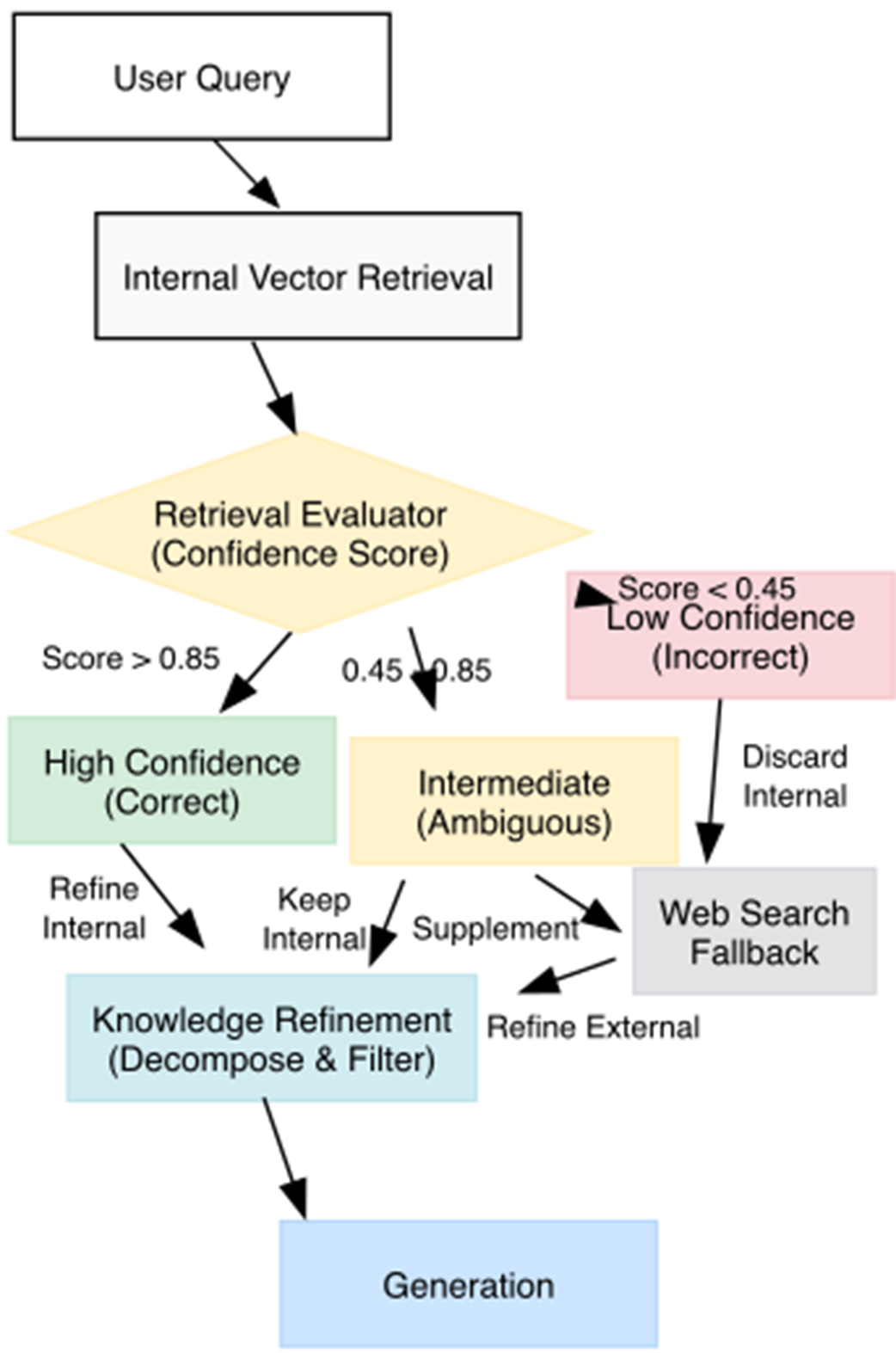
Use the architecture diagram to trace how evaluator output selects refinement, rejection with web search, or hybrid retrieval. section 11.2.1















