Container orchestration coordinates the deployment and scaling of containerized applications across a cluster of machines. Docker can run containerized tasks on one machine; Kubernetes distributes them across multiple worker nodes. section 11.5 section 11.5.1
Kubernetes schedules containers onto nodes while considering needs such as CPU, memory, storage, and specialized hardware. Its control plane manages the cluster; worker nodes run assigned applications. A pod is the smallest Kubernetes work unit, and an Airflow task can run as a container inside one. section 11.5.1
In an Airflow workflow, use orchestration to coordinate work, and offload substantial processing to systems suited to that work. For example, query databases where data resides or run big-data computations on an external Spark cluster rather than scaling Airflow workers to process everything. section 12.3.5 section 8.4
Figure 11.10 High-level overview of Kubernetes
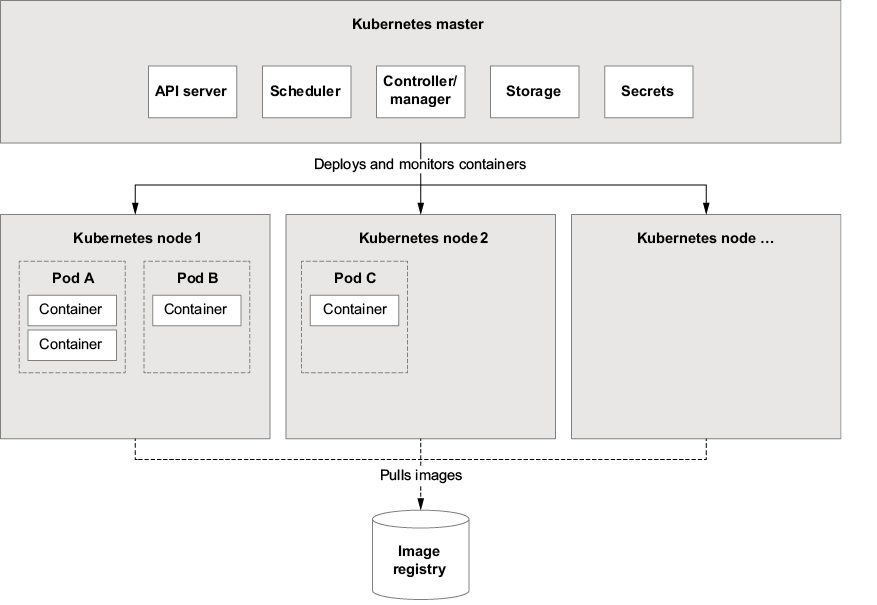
A high-level diagram of Kubernetes components and how they relate to running applications across a cluster. section 11.5.1










