liveBook · Manning

Agent orchestration

As explained in Kubernetes for Developers

A container orchestrator is a platform that schedules, operates, scales, and maintains containerized workloads across compute resources.

Running containers directly on individual machines can make each host a special case and require hands-on configuration as the application grows. A container orchestrator such as Kubernetes schedules and monitors containers across a shared pool of machines, so teams can focus on deploying applications instead of managing each host. section 1.2 section 3.0

Describe what the deployment needs—such as the number of container instances, availability, and service networking—and the orchestrator manages where containers run. This supports multiple services on shared compute, including stateless applications, databases, and batch jobs. section 3.0

Orchestration helps teams:

  • Scale applications without configuring each machine individually. section 1.2
  • Spread services across failure domains to support high availability. section 1.2
  • Roll out service updates by changing configuration and letting Kubernetes apply them across zones. section 1.2
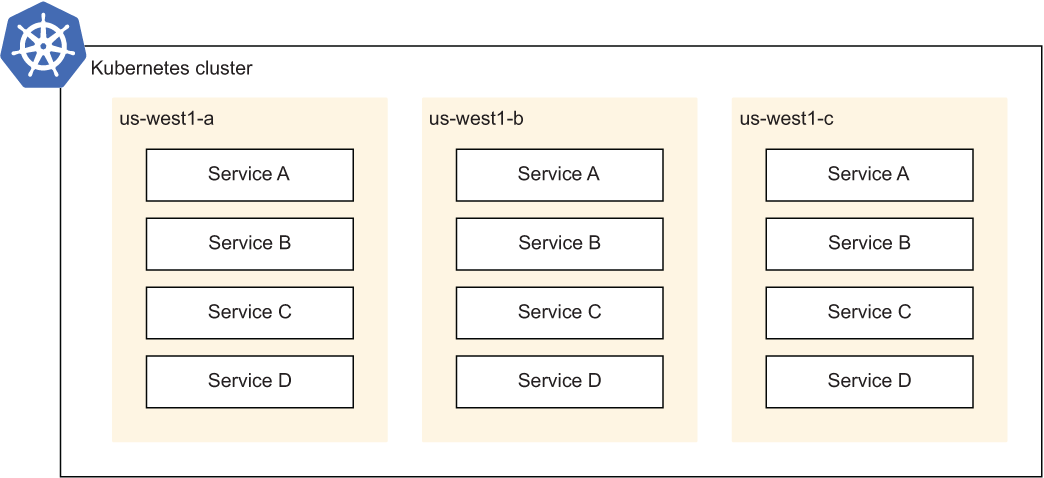
Figure 1.6 A Kubernetes cluster operating in three zones, managing four services
01-06

Shows a Kubernetes cluster managing several services across three zones. section 1.2

How Kubernetes for Developers covers it

How deep it goes
Defines scheduling and monitoring, then explains deployment attributes and operational benefits without detailing implementation internals.
Examples
Illustrates multi-zone services, service rollouts, and deployments ranging from databases to batch jobs.
What it assumes
Assumes familiarity with containers and their packaging role rather than teaching containerization from zero.
What you can do after
Operate deployments by specifying replica counts, availability needs, and service networking instead of choosing machines.
How it connects
Connects Kubernetes with containers, clusters, microservices, service networking, and high availability.

Also explained in

Compare how 11 books explain agent orchestration →

Related concepts

This explainer was generated by Manning's knowledge graph from the text of Kubernetes for Developers. The section links point to the parts of the book it draws on.









