When a task needs several steps, tools, or specialized agents, agent orchestration coordinates how the parts work together. Orchestration frameworks let developers configure agent roles, tool access, and memory across interactions, shifting the work from writing prompts to designing dynamic systems. section 8.26
A multi-agent system can assign distinct roles, pass tasks between agents, and share context toward a common goal. Frameworks named for this approach include AutoGen, LangChain, LangGraph, the OpenAI Assistants API, and Azure AI Foundry. Swarm introduced coordination patterns for role-based handoffs and shared state; it has since been succeeded by the OpenAI Agents SDK. section 8.26 section 8.9
Figure 8.4 Coordinated multi-agent workflow with specialized agents handling distinct subtasks
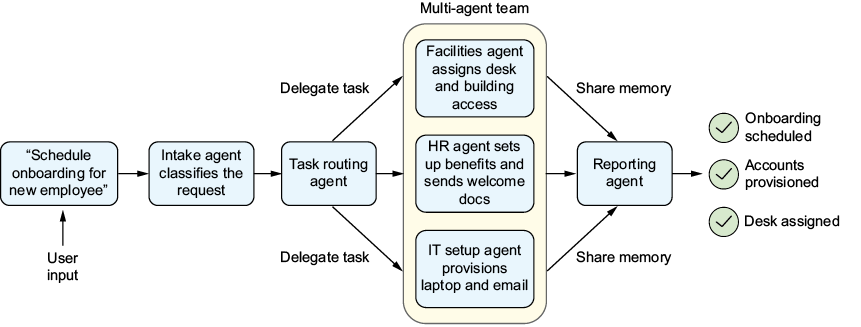
A coordinated workflow diagram makes the division of subtasks among specialized agents easier to see. section 8.9
Orchestration can make complex workflows modular, but greater autonomy raises the stakes of errors and hallucinations and complicates control. Many multi-agent systems remain under human supervision. Evaluating them also requires attention to actions and behavior over time, not only the accuracy or coherence of individual outputs. section 8.9 section 10.3