Data is recorded information from which computational systems detect patterns or learn behavior. More examples can help a model learn, but data alone does not make an AI system effective. section 1.2.1
Why quality matters
Imagine training a system on outdated medical advice. It may produce fluent, confident answers while repeating obsolete or incorrect patterns. The issue is not simply how the model learns; noisy, biased, or wrong data shapes what it learns. section 1.2.1
Useful data must work alongside other conditions:
- More data increases processing, storage, and training demands, turning a data problem into a compute problem. section 1.2.1
- Data can become outdated as language, facts, and knowledge change, causing predictions to reflect an earlier reality. section 1.2.1
- Progress accelerates when data, computational power, and algorithms improve together; lacking any one limits the others. section 1.4
Figure 1.6 A high-level timeline of language models and AI systems (1950s–present), showing the progression from early rule-based systems and chatbots to neural networks, sequence models, and modern large language and multimodal systems, along with recurring cycles of progress and setbacks known as AI winters.
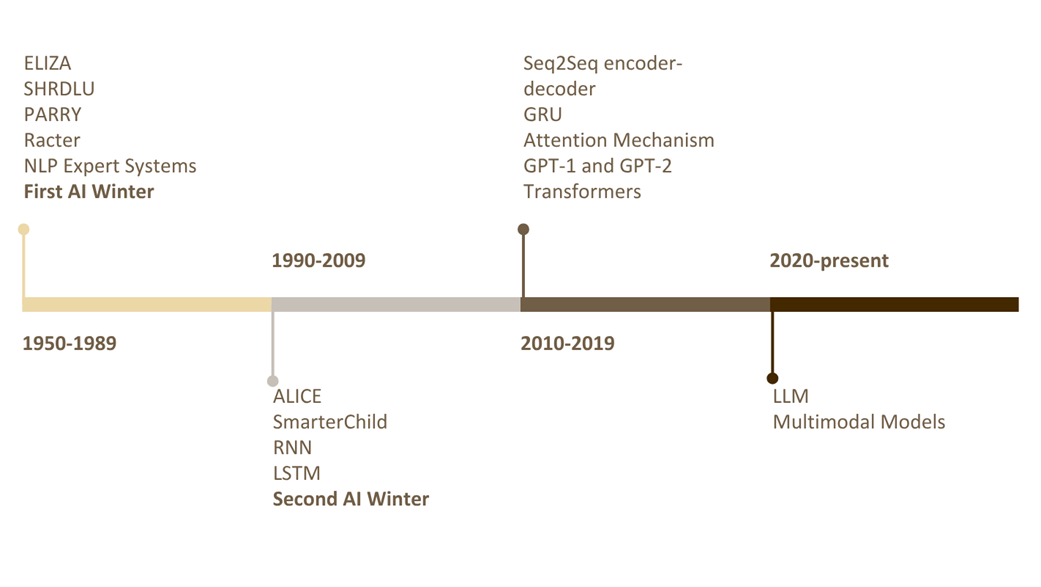
A timeline places data alongside changing algorithms and hardware, showing why familiar ideas became practical only when surrounding conditions aligned. section 1.4