A marketer may need to know whether a location attracts visitors or a campaign drives sales without examining each person’s record. Data aggregation combines individual records into totals, averages, or broader categories. It preserves useful patterns while reducing the ability to isolate an individual data point. section 2.3.3
Keep the measure, not the visit
A retailer can report total visitor counts or average dwell time by location without including exact timestamps or precise locations. A health-focused brand can group customers into age brackets when evaluating fitness product sales. Both choices trade individual-level detail for a less revealing view. section 2.3.3
Aggregation is one privacy choice, not a substitute for every other safeguard:
- Data minimization limits analysis to information needed for a specific business objective. section 2.3.3
- Anonymization removes or irreversibly alters identifying information; pseudonymization obscures identifiers but may still permit relinking. Aggregation instead summarizes records so individual points are harder to isolate. section 2.3.3
- In a data clean room, partners can match protected identifiers, aggregate matched records, and receive audience segments or performance reports rather than raw consumer data. section 8.1 section 8.2
Figure 8.4 A high-level secure matching process in a data clean room
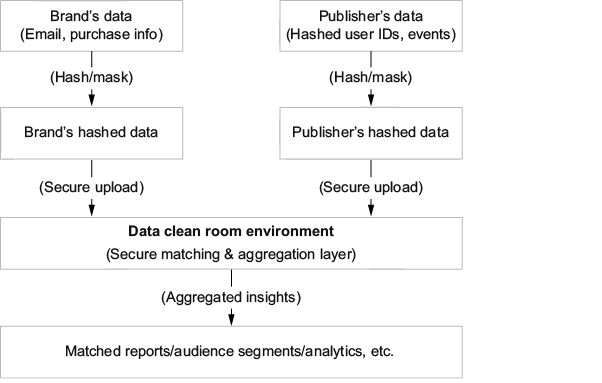
The secure-matching workflow places aggregation between matching protected records and delivering insights, clarifying where individual records become reportable summaries. section 8.2
The practical decision is how much detail the objective requires. Use summaries when totals, segments, or performance measures answer the question; protect the matching and reporting process as well. Clean-room access controls and agreed hashing methods help partners manage who can match data and receive insights. section 2.3.3 section 8.2


















