Data analysis systematically examines data to generate insights and identify trends that support business and technical decisions. It depends on well-defined problems, usable data, and disciplined data management. section 1.3 section 1.7
A practical analysis workflow connects several responsibilities:
- Define and scope the business problem before beginning the technical process. section 1.7
- Prepare data through engineering operations such as exporting, transforming, cleaning, and loading. section 1.3
- Check completeness, validity, accuracy, representativeness, availability, consistency, timeliness, and integrity before relying on results. section 1.7
- Use analysis alongside statistics, visualization, business intelligence, data mining, and machine learning rather than treating it as an isolated function. section 1.3
Figure 1.7 How the various fields are interlinked with each other and how they are dependent on each other
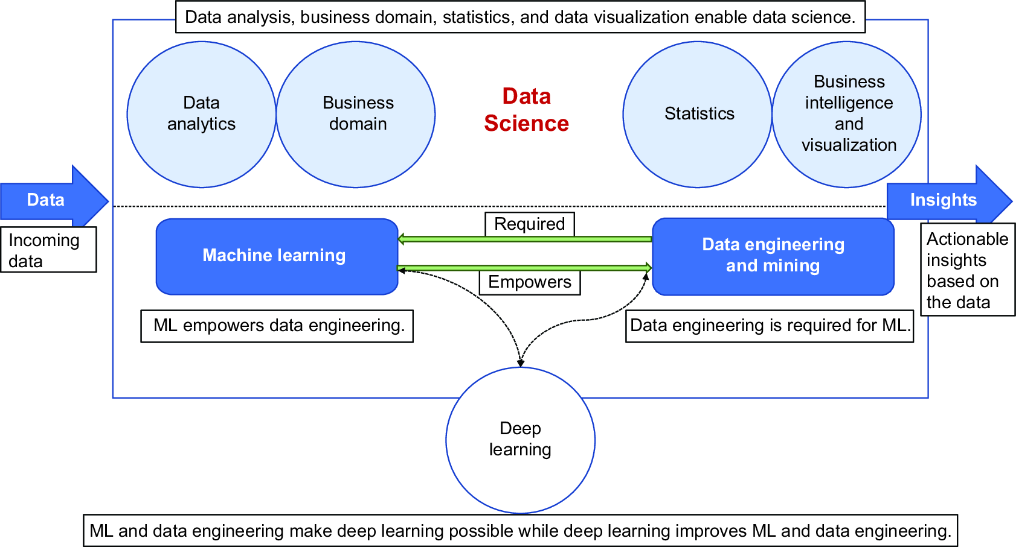
Use the field-interconnection diagram to navigate how data analysis relates to data engineering, business intelligence, visualization, data science, machine learning, and AI. section 1.3









