liveBook · Manning

Data augmentation

As explained in Deep Learning with JAX

The practice of creating modified training examples to increase diversity and improve model robustness.

Need more varied training data without collecting more images? Data augmentation creates modified examples, such as noisy or rotated images, to improve robustness and reduce overfitting. section 9.1

A practical image-classification augmentation setup can:

  • Add random noise to existing training images. section 9.1
  • Apply random rotations to increase dataset diversity. section 9.1
  • Use JAX's functional random-number keys rather than hidden mutable generator state. section 9.0

Noisy and rotated images

Imagine training an image classifier. Randomly adding noise and rotating each image produces varied training examples, helping the network become more robust while acting as implicit regularization. section 9.1

Figure 9.1 Scheme of the data augmentation process
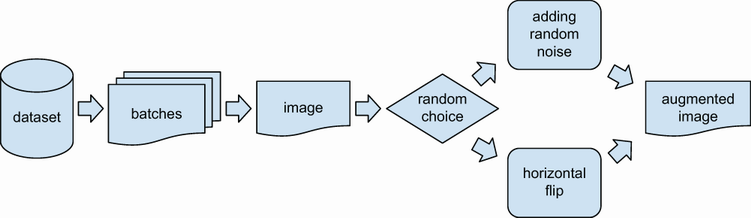
Use the process diagram to visualize how original images become varied training examples. section 9.1


How Deep Learning with JAX covers it

How deep it goes
Explains augmentation through two image transformations and connects it to implicit regularization and random-number handling.
Examples
Demonstrates image classification with random noise and random rotations applied to training images.
What it assumes
Assumes image-classification training and introduces augmentation through random noise and rotations.
What you can do after
Apply data augmentation with JAX's functional random-number model to diversify image-classification training data.
How it connects
Links data augmentation to random numbers, implicit regularization, overfitting, and functional programming.

Also explained in

Compare how 9 books explain data augmentation →

Related concepts

This explainer was generated by Manning's knowledge graph from the text of Deep Learning with JAX. The section links point to the parts of the book it draws on.





