liveBook · Manning

Data augmentation

As explained in Machine Learning for Tabular Data: XGBoost, Deep Learning, and AI

A technique that expands or diversifies training data by applying label-preserving transformations or generating additional examples.

Data augmentation expands or diversifies training data through label-preserving transformations or additional examples. It can mitigate deep learning’s disadvantage on smaller datasets, where limited rows make generalization harder. section 12.1

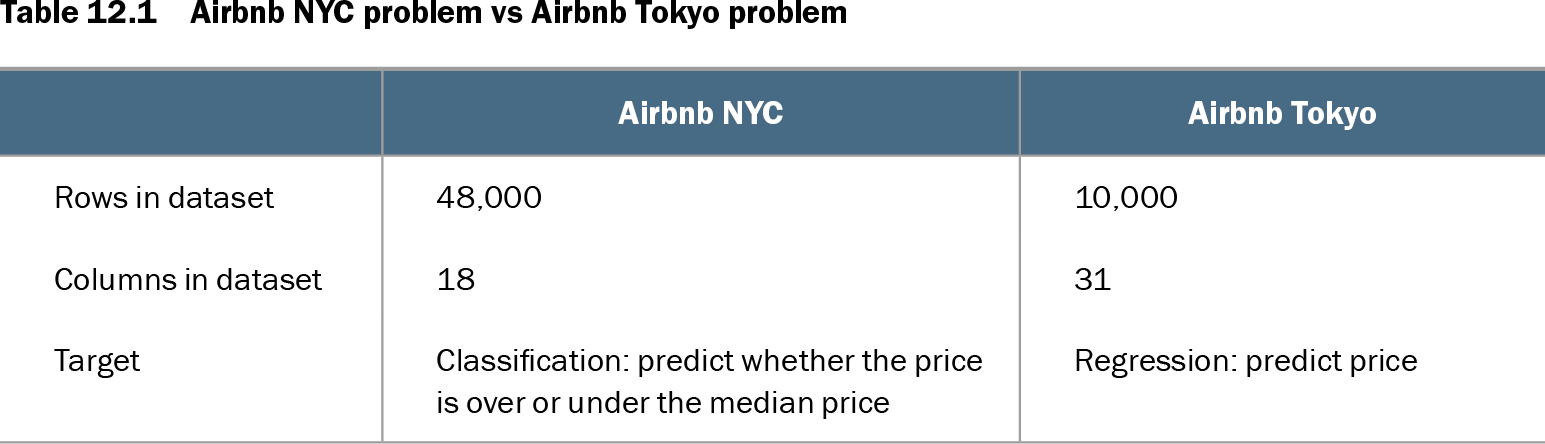
Table 12.1 Airbnb NYC problem vs Airbnb Tokyo problem (view table figure)

Airbnb NYC

Airbnb Tokyo

Rows in dataset

48,000

10,000

Columns in dataset

18

31

Target

Classification: predict whether the price is over or under the median price

Regression: predict price

Compare the 48,000-row New York City Airbnb dataset with the 10,000-row Tokyo dataset to assess why augmentation may matter. section 12.1


How Machine Learning for Tabular Data: XGBoost, Deep Learning, and AI covers it

How deep it goes
Defines augmentation’s purpose but stops short of describing transformations, implementation steps, or evaluation procedures.
Examples
Uses the Tokyo and New York City Airbnb datasets to illustrate contrasting data volumes and deep-learning challenges.
What it assumes
Assumes familiarity with machine learning, deep learning, training data, overfitting, and model generalization.
What you can do after
Evaluate when augmentation may help a deep-learning model facing limited training data.
How it connects
Connects data augmentation with deep learning, classical machine learning, feature engineering, overfitting, and generalization.

Also explained in

Compare how 12 books explain data augmentation →

Related concepts

This explainer was generated by Manning's knowledge graph from the text of Machine Learning for Tabular Data: XGBoost, Deep Learning, and AI. The section links point to the parts of the book it draws on.