Data augmentation creates or transforms training examples to increase dataset variety while preserving task-relevant information. In vision applications, it can address scarce data, limited diversity, and rare edge cases. section 4.1 section 4.1.2
GAN-based augmentation is useful when:
- Training data is insufficient for a target visual task. section 4.1.2
- Rare edge cases need additional examples. section 4.1.2
- Training data lacks the diversity needed for realistic scenarios or simulations. section 4.1 section 4.1.2
Training simulations
An education system can use augmented visual data to create realistic and diverse training scenarios based on learner progress, supporting interactive simulations. section 4.1
Figure 4.5 GAN model architecture
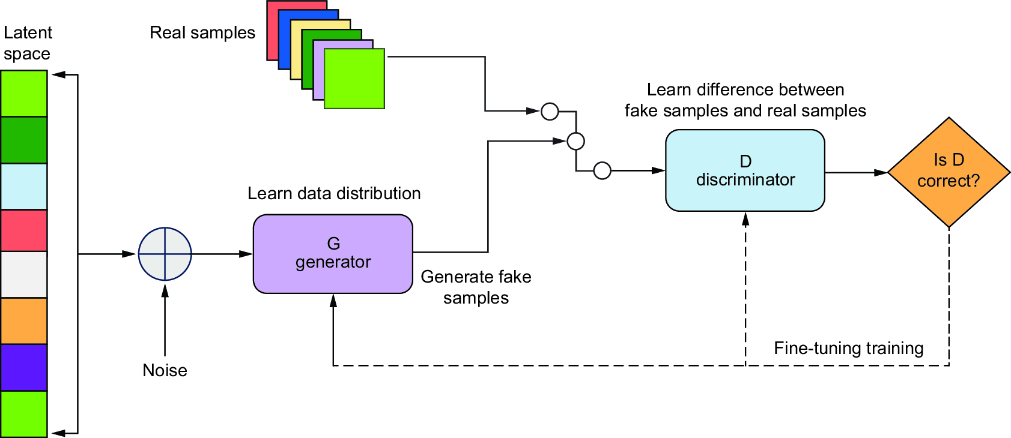
Inspect the GAN architecture to see the generator, discriminator, latent space, and fine-tuning relationship behind synthetic-data generation. section 4.1.2
Validate generated examples carefully: GANs may repeat outputs through mode collapse, behave unstably, offer limited control, or reproduce training-data bias. Generated content can also create privacy, misinformation, and misrepresentation risks. section 4.1.2








