Data collection acquires data for a defined modeling problem after measurable KPIs are identified. Relevance, quality, representativeness, diversity, and lineage shape every downstream modeling step. section 2.1.1
A production-oriented collection process checks:
- Relevance to the target domain and sufficient scale for problem complexity. section 2.1.1
- Quality, balanced representation, harmful-bias prevention, and avoidance of unintentional sample leakage. section 2.1.1
- Deployment-representative distributions, domain diversity, and detailed lineage for raw, intermediate, augmented, and annotated data. section 2.1.1
Lineage records when, where, how, and why data was collected. It supports dataset versioning, exposes limitations, guides feature selection, and preserves maintainability as the dataset evolves. section 2.1.1
Enterprise data from scratch
Unlike research settings that may use reviewed open datasets, enterprise teams often collect domain-specific data from the deployment environment and fine-tune models with it. Annotated computer-vision data can be produced with CVAT. section 2.1.1
Figure 2.4 Example of an annotated ID card, shown in the CVAT web-based tool designed for annotating images and videos, which is commonly used to label data for computer vision models
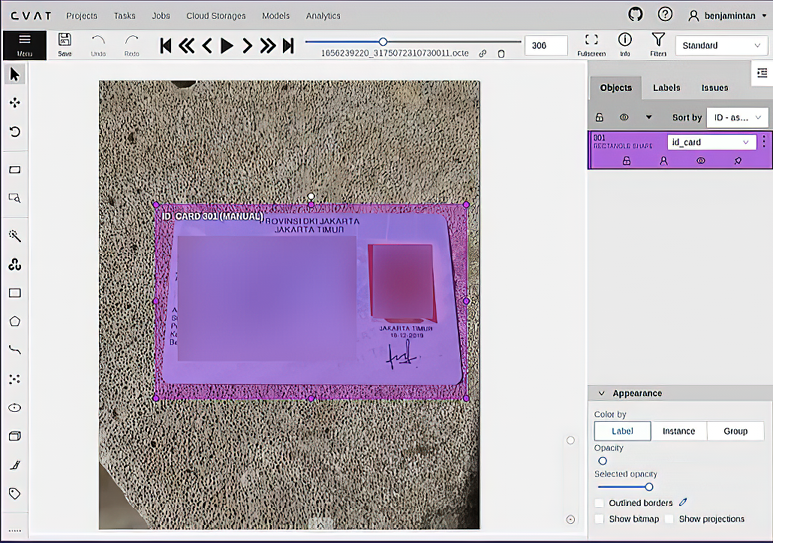
Inspect an annotated identity-card image to see how collected visual data becomes labeled training data. section 2.1.1









