Preprocessing turns raw data into a reliable foundation for model development. Its quality directly affects model reliability and efficacy, so it belongs inside an iterative, automated ML workflow rather than a one-off notebook task. section 7.0 section 1.1.1
A production-oriented preprocessing workflow typically:
- Explores data interactively with Kubeflow notebooks before formalizing repeatable transformations. section 7.0
- Downloads or collects the dataset as a distinct pipeline stage. section 7.3
- Splits data into training, test, and validation datasets. section 7.3
- Packages each operation as a composable, well-defined Kubeflow component. section 7.3
- Revisits preparation when training or evaluation exposes dataset problems. section 1.1.1 section 1.4.1
Object-detection preparation pipeline
An ID-card detection workflow downloads the dataset, divides it into training, test, and validation sets, and connects the two operations into one executable Kubeflow Pipeline. The same preparation pattern supports broader capstone workflows, including movie recommendation. section 7.0 section 7.3
Figure 7.1 The mental map where we’re now focusing on the first step/component of our pipeline—data collection and preparation (3)
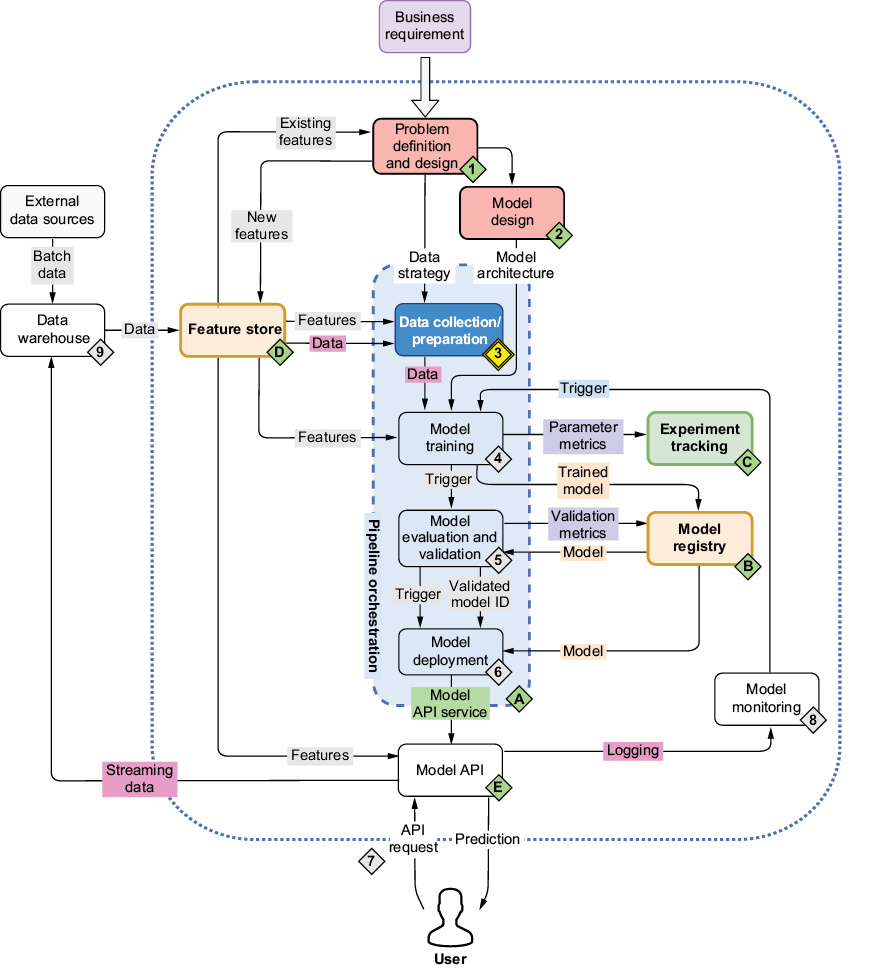
Use the pipeline mental map to locate preprocessing at the data collection and preparation stage. section 7.0





















