A decoder reconstructs a message from its encoded form at the receiving end of a communication system. It uses structure introduced during encoding to recover the original as accurately as possible, despite possible corruption by channel noise. section 5.2
Reconstructing an image
An image encoder can compress millions of pixels into a compact latent representation that preserves informative structure. A decoder uses that representation to recover an image resembling the original, though many pixels are no longer represented explicitly. section 5.4.2
Figure 5.3 Representation learning as information-preserving compression. An encoder transforms a high-dimensional image into a compact latent representation by preserving the image's informative structure while reducing redundant detail. Although many original pixels are no longer represented explicitly, the latent representation retains the information needed for a decoder to reconstruct an image that closely resembles the original.
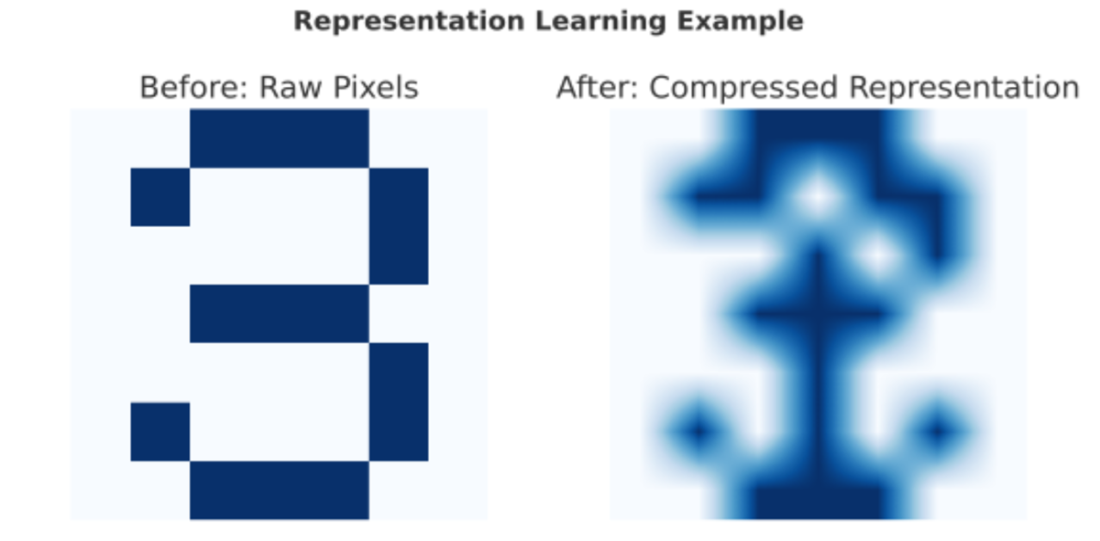
Trace how an encoder compresses an image into a latent representation and how a decoder reconstructs it. section 5.4.2