A discriminative model learns to separate data classes or predict target values from input data. It focuses on decision boundaries rather than modeling the full data-generating distribution. section 5.0 section 5.1.1
A typical supervised classification workflow is:
- Train on labeled examples, treating the input as X and the desired target as Y. section 5.1 section 5.1.1
- Learn the conditional relationship P(Y|X), such as whether an image is a boat or an airplane. section 5.1 section 5.1.1
- Apply the learned boundary to unseen test data and return a predicted target label. section 5.1.1
Convolutional and attention-based graph neural networks are examples of discriminative models. They can identify patterns for graph-learning tasks such as node classification without learning the entire graph data distribution. section 5.0
Boat-versus-airplane classification
A model may distinguish boats from airplanes using telltale features such as a mast, keel, or boom. It need not model broader correlations such as airplanes having wings or boats appearing near water. section 5.1.1
Figure 5.1 Comparison of generative and discriminative tasks. On the left, the discriminative model learns to separate different images of boats and airplanes. On the right, the generative model attempts to learn the entire dataspace, which allows for new synthetic examples to be created such as a boat in the sky or an airplane on water.
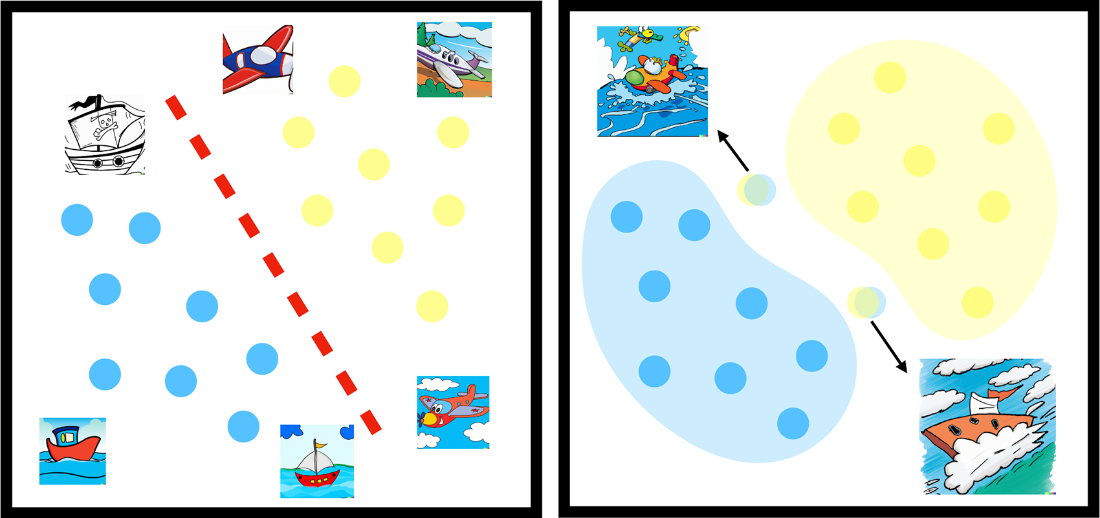
Compare discriminative boundary separation with generative modeling of the entire dataspace and synthetic-example creation. section 5.1.1



