A discriminative model recognizes and categorizes existing content by learning how input features distinguish among classes. It estimates conditional probabilities such as P(Y|X), then assigns the label with the highest predicted probability. section 1.1 section 1.1.1
Unlike a generative model, which learns a joint distribution to create new instances, a discriminative model focuses on the boundary between labels rather than synthesizing content. section 1.1.1
A typical classification task proceeds as follows:
- Provide an input, such as an image containing a dog or cat. section 1.1.1
- Use distinguishing features, such as small noses or pointy ears, to estimate Prob(dog) and Prob(cat). section 1.1.1
- Choose the label with the highest predicted probability. section 1.1.1
Figure 1.1 A comparison of generative models versus discriminative models. A discriminative model (top half of the figure) takes data as inputs and produces probabilities of different labels, which we denote by Prob(dog) and Prob(cat). In contrast, a generative model (bottom half) acquires an in-depth understanding of the defining characteristics of these images to synthesize new images representing dogs and cats.
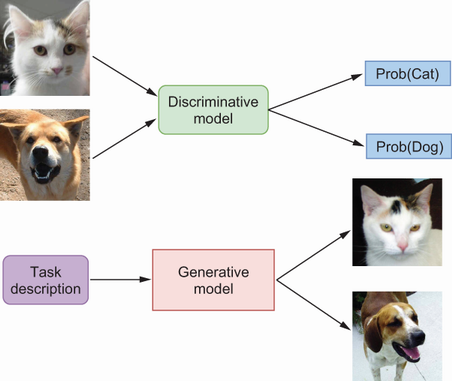
Compare the input-to-label workflow of discriminative models with the content-generation workflow of generative models. section 1.1.1



