A false negative happens when an example is truly positive, but a classifier predicts negative. If “sick” is the positive label, a sick person diagnosed as healthy is a false negative. If “spam” is positive, spam classified as ham is a false negative. The word false means the prediction is wrong; negative means the model chose the negative class. section 7.5 section 7.18
False negatives matter because an overall error count or high accuracy can hide them. In medical diagnosis, missing sick people can be more serious than incorrectly flagging healthy people. The appropriate balance depends on which mistake costs more for the problem being solved. section 7.7 section 7.11
Recall focuses on this kind of miss: it asks, among all truly positive examples, how many were correctly predicted positive. It is calculated as true positives divided by true positives plus false negatives. More false negatives lower recall. section 7.7 section 7.18
Reading a confusion matrix
For a coronavirus model, suppose 10 people are sick. If the model diagnoses 8 as sick and 2 as healthy, those 2 are false negatives. The model found 8 of 10 positive cases, so its recall is 8/10, or 0.8. A model can make fewer total mistakes yet still be worse when its errors are mostly missed positive cases. section 7.7 section 7.7
Figure 7.1 Examples of two models that are widely used in real life and that we’ll use throughout this chapter. On the left, a coronavirus model where the people are diagnosed as healthy or sick. On the right, a spam-detection model where the emails are classified as spam or ham. For each model, we have highlighted some of their errors and separated them as false positives and false negatives.
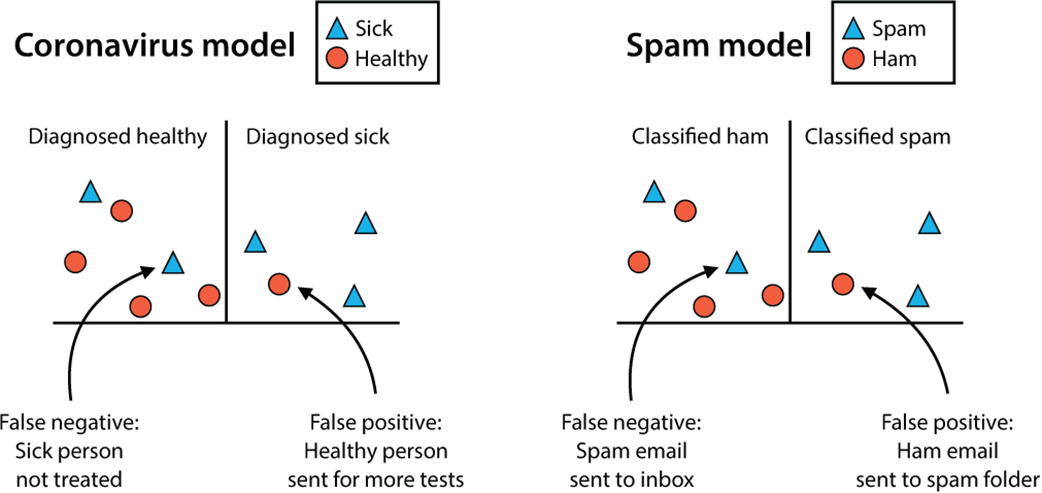
Use the diagram to compare the two error directions: positive examples predicted negative are false negatives, while negative examples predicted positive are false positives. section 7.5
When judging false negatives, ask:
- Which class is defined as positive? A false negative can only be identified after that choice. section 7.5
- How costly is it to miss a positive case compared with raising a false alarm? section 7.11
- Should recall receive more weight than precision? When avoiding false negatives is especially important, recall deserves greater emphasis. section 7.18 section 7.11















