A false negative occurs when an outlier detector labels a record as an inlier even though it is an outlier relevant to the task. It is a missed finding. The opposite error, a false positive, labels an inlier as an outlier. Deciding how many records to investigate means balancing these two errors. section 14.0 section 1.1.5
A missed process change
Consider temperature readings compared with data from normal operation. Unusually high fluctuation near 200 seconds and unusually low fluctuation near 800 seconds are potential anomalies. If either change reflects an issue but the detector reports normal operation, that decision is a false negative. section 1.1.5
Figure 1.1 Temperature readings from sensor data presented as a time series. The x-axis tracks time in seconds and the y-axis tracks the temperature. There is an unusually high level of fluctuation at 200 seconds and an usually low level at 800 seconds.
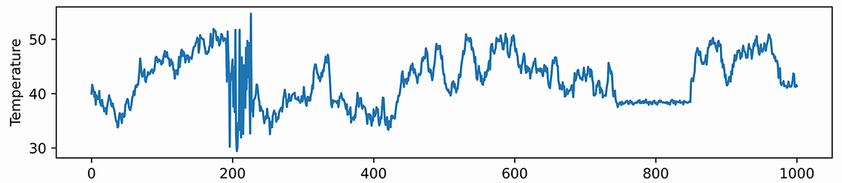
The temperature time series shows two different deviations that a detector should consider; missing a genuine issue at either point would be a false negative. section 1.1.5
Reducing missed outliers requires attention to both detection and evaluation:
- Use multiple, diverse detectors when the outliers of interest are not narrowly known; an ensemble can reduce errors that one detector makes. section 14.0
- Evaluate score ranking before choosing thresholds for binary labels. The useful threshold depends on the investigation context and the relative importance of false positives and false negatives. section 8.5.2
- Treat findings from very small datasets cautiously: apparent outliers can mask genuinely unusual records, and models trained on small samples may initially be unreliable. section 10.3
A “true” outlier label is often a practical judgment about relevance, not an unquestionable statistical fact. In large or complex datasets, inspecting every record accurately may be impossible, so observed error counts cannot be assumed to capture every miss. section 14.0















