A false positive occurs when a system flags legitimate activity as suspicious, such as blocking a legitimate financial transaction. It can create customer friction, erode trust, and increase operational burden; fraud detection therefore weighs it against the losses caused by missed fraud. section 1.3.1 section 7.3
Fraud-model evaluation makes false positives visible through related measures:
- A confusion matrix counts legitimate transactions wrongly flagged as fraud as false positives. section 8.3.3
- Precision measures the share of flagged transactions that are actually fraud; optimizing it reduces false positives and customer friction. Recall instead emphasizes catching actual fraud. section 8.1.1
A fraud-model tradeoff
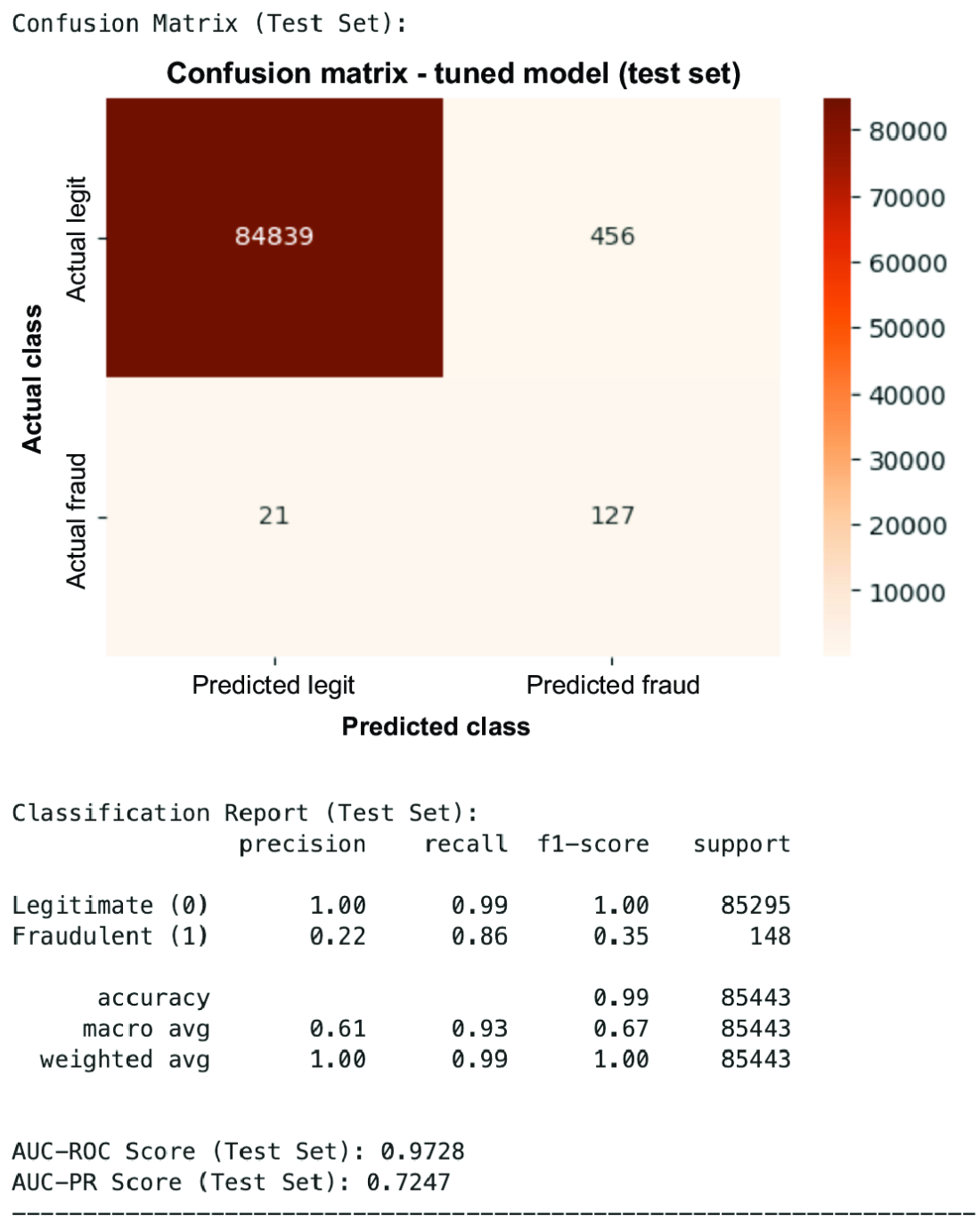
On a test set, a tuned model caught 127 of 148 actual frauds, with recall of 0.86. Its precision was 0.22, and it incorrectly flagged 456 legitimate transactions. section 8.3.3
Figure 8.6 Performance of the tuned model on the test set. This comprehensive evaluation highlights the model’s strengths and tradeoffs. It achieves a high recall of 0.86 for fraudulent transactions (Class 1), successfully identifying 127 out of 148 actual frauds. But the confusion matrix shows that this comes at the cost of low precision (0.22), resulting in 456 legitimate transactions being incorrectly flagged as fraudulent (false positives). The AUC-PR score of 0.7247 reflects this precision-recall tradeoff.
Compare fraud recall with precision and the number of legitimate transactions incorrectly flagged. section 8.3.3


















