A false positive occurs when a classification model predicts the positive class for an example whose true class is negative. It is an incorrect positive prediction. section 7.5 section 7.18
Everyday classification examples
In a medical model, a false positive is a healthy person incorrectly diagnosed as sick. In a spam filter, it is a legitimate ham email incorrectly classified as spam. The positive label depends on the task: sickness in the first example and spam in the second. section 7.5
Use the confusion matrix to distinguish this error from related outcomes:
- False positive: the actual class is negative, but the prediction is positive. section 7.5
- False negative: the actual class is positive, but the prediction is negative. section 7.5
- True positive and true negative are correct positive and negative predictions. section 7.5
False positives matter because different applications assign different costs to errors. Precision falls when a model produces many false positives, while recall focuses on finding positive cases and tolerates more mistaken positives. section 7.18 section 7.7
Figure 7.1 Examples of two models that are widely used in real life and that we’ll use throughout this chapter. On the left, a coronavirus model where the people are diagnosed as healthy or sick. On the right, a spam-detection model where the emails are classified as spam or ham. For each model, we have highlighted some of their errors and separated them as false positives and false negatives.
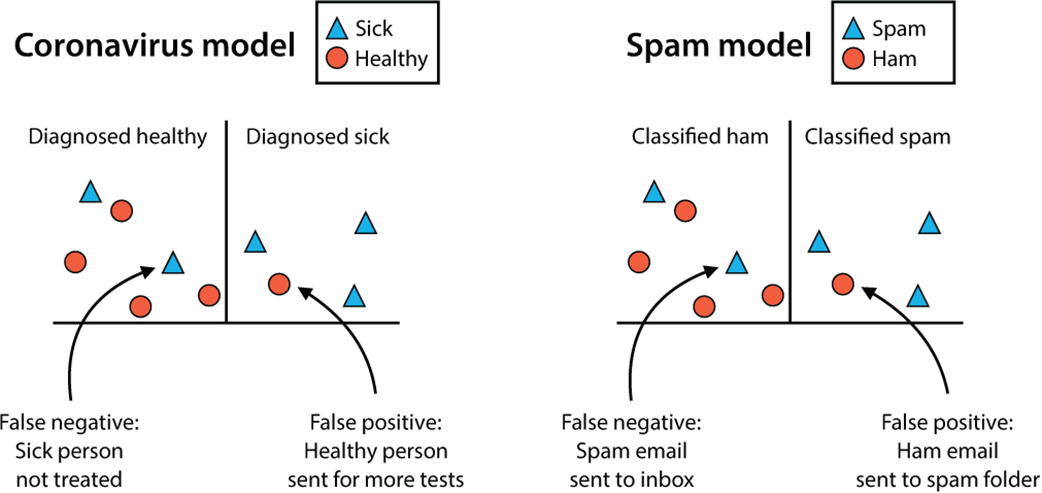
Compare false positives and false negatives visually in medical diagnosis and spam detection. section 7.5