A false positive is a false alarm: a classifier reports a positive condition when it is absent. In a risk model, it means labeling a case high risk when it is not. False alarms can consume review time and erode trust, even when the system is fast and inexpensive. section 4.6.5 section 9.1
The decision threshold controls the tradeoff. Lowering it classifies more cases as high risk, potentially catching more real risks while increasing false positives. Raising it shifts more predictions to low risk, potentially missing real risks. Compare precision and recall across thresholds rather than choosing a cutoff on accuracy alone. section 4.6.5 section 4.6.3
A threshold changes the classification
At a threshold of 0.3, a predicted probability of 0.31 is classified as high risk. At a threshold of 0.6, a probability of 0.55 is classified as low risk. Whether either classification is a false positive depends on the actual condition. section 4.6.5
Figure 4.11 Precision vs. Recall at Different Thresholds.
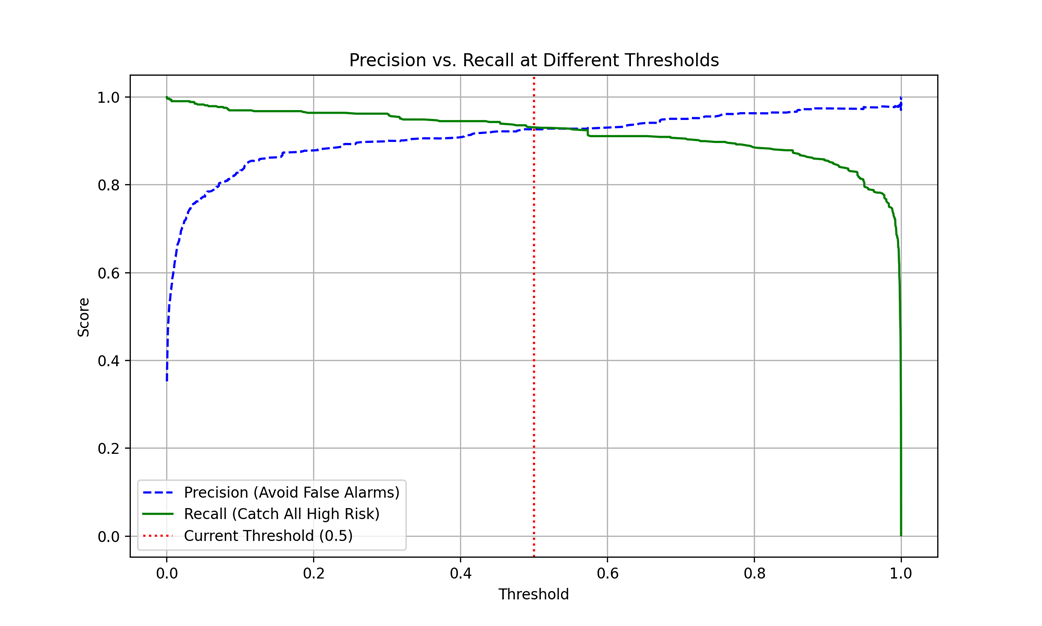
Use the precision and recall plot to compare the effects of different thresholds. section 4.6.5
Review noise becomes a hidden cost
A CI code-review agent switched to a cheaper model. Its false-positive review comments rose from roughly 8% to 18% as it flagged correct code as problematic. Developers began ignoring its comments, and senior engineers returned to full manual reviews. section 9.1
Check false alarms against the cost of missed problems and the effort needed to investigate findings. Generated tests also need review: their validity and design should be checked so they do not introduce false positives. section 9.1 section 2.4.1