liveBook · Manning

False positive

As explained in First-Party Data Activation

A false positive is a classification outcome in which the system incorrectly identifies records from different individuals as belonging to the same individual.

A false positive occurs when identity resolution incorrectly treats records from different individuals as belonging to one person. The error creates a misleading customer profile and can distort personalization. section 6.1

When a shared IP address misleads a campaign

If Target assumes every purchase from Brittany’s parents’ house was hers, it may recommend products suited to her parents. Campaigns become ineffective and may contribute to churn. section 6.1

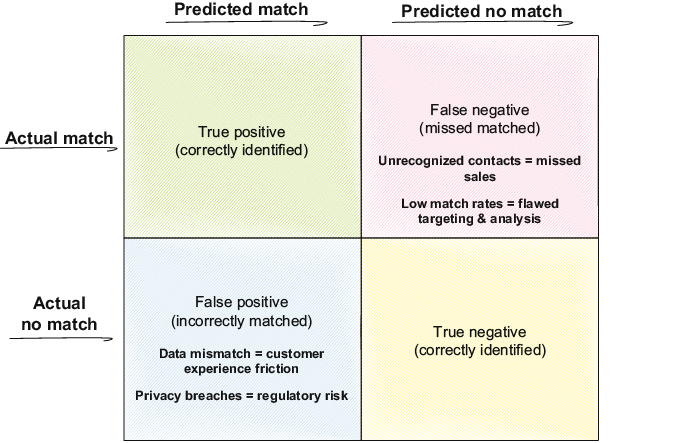
Identity-resolution teams compare false positives with false negatives in a confusion matrix, creating shared language for assessing matching risks and choosing thresholds and strategies. section 6.1

Figure 6.2 Identify resolution confusion matrix
A diagram of a match

AI-generated content may be incorrect.

Use the identity-resolution confusion matrix to compare false-positive outcomes with true-positive and false-negative matches. section 6.1


How First-Party Data Activation covers it

How deep it goes
Defines the error, illustrates consequences, and places it in a confusion matrix without detailing matching algorithms.
Examples
Uses a shared household IP address and Target’s personalized product recommendations to demonstrate the error’s consequences.
What it assumes
Assumes awareness of customer records and identity resolution while defining false positives through a concrete retail scenario.
What you can do after
Evaluate identity-resolution results by recognizing false positives and comparing them with other confusion-matrix outcomes.
How it connects
Connects false positives with identity resolution, false negatives, confusion matrices, matching thresholds, and customer lifetime value.

Also explained in

Compare how 26 books explain false positive →

Related concepts

This explainer was generated by Manning's knowledge graph from the text of First-Party Data Activation. The section links point to the parts of the book it draws on.