A feature map is the output produced when a convolutional filter scans an image. It records detected spatial patterns and becomes an intermediate representation for later layers. section 4.2.1
A convolution creates a feature map by:
- Sliding a filter across different image regions while reusing the same weights. section 4.2.1
- Multiplying corresponding input and filter elements, then summing the results at each position. section 4.2.1
- Producing one output channel for each learned feature set selected by out_channels. section 4.2.1
A small PyTorch feature map
A 3×3 grayscale tensor passed through a 2×2 convolution with stride 1 and no padding produces a 2×2 feature map. Setting the filter weights to [[1,2],[3,4]] and the bias to 0 yields [[7,14],[54,50]]. section 4.2.1
Figure 4.5 A numerical example of how convolutional operations work, with stride equal to 1 and no padding
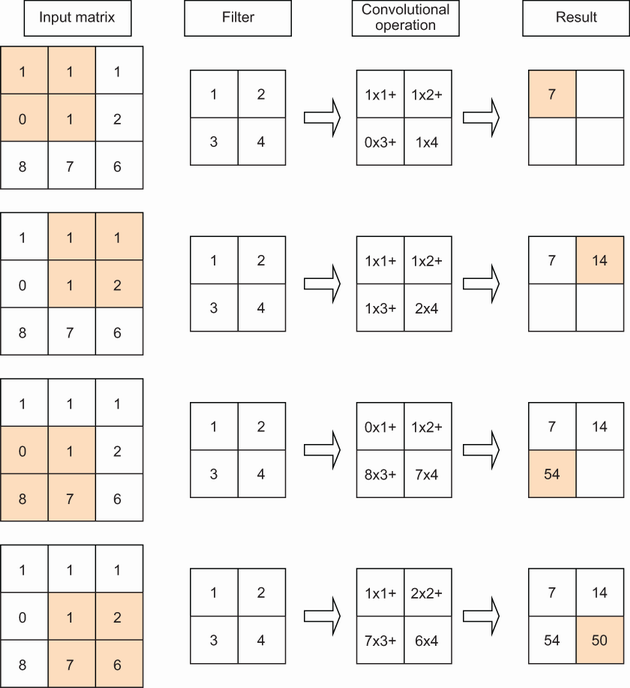
Inspect the numerical sliding-window calculation behind the feature-map values. section 4.2.1







