A convolution kernel is a learned weight matrix that transforms each extracted input patch into an output feature vector. Sliding across an image, the same kernel evaluates the same local pattern at every position, producing a response map. Early kernels commonly respond to edges or textures; later kernels can respond to increasingly abstract visual concepts. section 8.1.1 section 10.4
A convolution layer is characterized by:
- Patch size, typically 3 × 3 or 5 × 5, defining the local region examined at each position. section 8.1.1
- Output depth, which determines how many kernels are learned and therefore how many output channels are produced. section 8.1.1
- A response map for each kernel, showing where its learned pattern appears across the input. section 8.1.1
- Window placement controlled by valid locations, padding, and strides, which affect the output dimensions. section 8.1.1
MNIST convolution layer
A first convolution layer can transform a 28 × 28 × 1 grayscale input into a 26 × 26 × 64 feature map. It applies 64 learned kernels over 3 × 3 patches; each output channel is a spatial response map for one kernel. A later stack can increase depth from 64 to 128 to 256, while successive layers represent more complex visual patterns. section 8.1.1
Figure 8.3 The concept of a response map: a 2D map of the presence of a pattern at different locations in an input
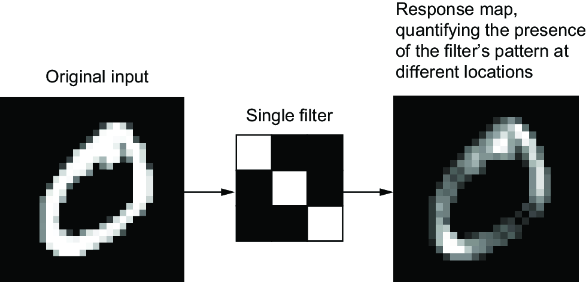
Use the response-map figure to see how one kernel records the presence of a learned pattern at different image locations. section 8.1.1
Kernel behavior can be inspected through intermediate activations. Plotting each channel separately reveals which patterns respond to an input; a first-layer channel may behave like a diagonal-edge detector, although learned channels can vary between training runs. section 10.1










