liveBook · Manning

Convolution kernel

As explained in Evolutionary Deep Learning: Genetic algorithms and neural networks

A convolutional filter is a learned array of weights that is slid across local input regions to produce feature responses.

A convolution kernel is a learned array of weights that slides across local image patches, producing one feature-response value per position. section 7.1

A simplified convolution workflow is:

  • Pass the kernel across the image with a stride, typically one pixel by one pixel. section 7.1
  • Apply the kernel to each local patch to create an output value and assemble those values into an output patch. section 7.1
  • Stack convolutional layers with different filter counts, then use pooling to summarize their increasingly large outputs. section 7.1

Keras convolution stack

A practical model starts with Conv2D(64, (3, 3)) for a 28×28×1 image, followed by max pooling, then 32-filter and 16-filter convolutional layers. The resulting model has 23,728 trainable parameters.
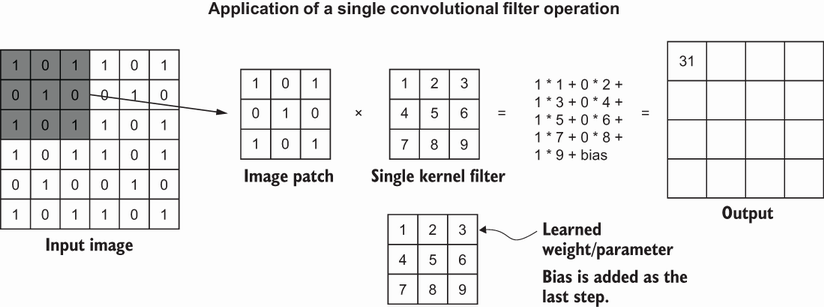
Figure 7.3 Demonstration of the convolutional filter operation

Inspect the visual demonstration of a kernel sliding across an image patch and producing an output value. section 7.1


How Evolutionary Deep Learning: Genetic algorithms and neural networks covers it

How deep it goes
Explains sliding, stride, learned weights, channel changes, and pooling, but avoids mathematical derivation.
Examples
Demonstrates Fashion-MNIST image patches, a visual filter operation, and a three-layer Keras Conv2D stack.
What it assumes
Assumes basic image tensors and channels, while demonstrating how to reshape grayscale images into channel-aware inputs.
What you can do after
Build convolutional image layers with Keras Conv2D and inspect their output shapes and parameter counts.
How it connects
Connects convolution kernels with convolutional neural networks, Conv2D layers, stride, channels, feature maps, and max pooling.

Also explained in

Compare how 11 books explain convolution kernel →

Related concepts

This explainer was generated by Manning's knowledge graph from the text of Evolutionary Deep Learning: Genetic algorithms and neural networks. The section links point to the parts of the book it draws on.







