A gradient is a vector of partial derivatives showing how a scalar function changes across multiple variables. In deep learning, it points toward increasing loss; its negative gives the steepest descent direction for reducing error. section 8.2.6
Gradient-based optimization updates model parameters iteratively:
- Batch gradient descent evaluates the training dataset before each update and seeks a function's global minimum, but can be slow for large or high-dimensional data. section 8.2.6
- Stochastic gradient descent updates coefficients after each training instance, reducing the time required for an iteration. section 8.2.6
- Mini-batch gradient descent updates from small data subsets, balancing speed and accuracy while introducing batch size as a tunable hyperparameter. section 8.2.6
Backpropagation calculates the loss gradient with respect to every neural-network weight. It works backward from the final layer, combines layer derivatives through the calculus chain rule, and updates weights to reduce loss over repeated iterations. section 8.4.1
Gradient updates in Boltzmann learning
A Boltzmann learning rule derives weight updates from the gradient of an energy function. Training decreases system energy by aligning visible-hidden activity in the data distribution with activity generated by the model. section 8.8.1
Figure 8.8 The concept of gradient descent. It is the mechanism to minimize the loss function.
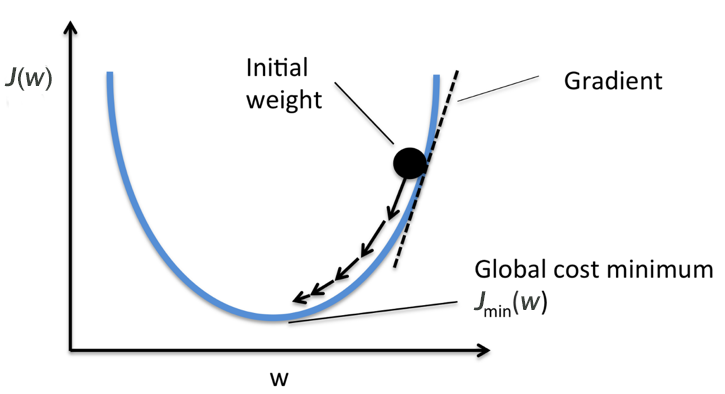
Use the figure to visualize gradient descent moving downward toward a global minimum while minimizing the loss function. section 8.2.6



















