A gradient combines a function’s partial derivatives into a vector. At any point, it points toward the function’s greatest increase. For a two-variable function, its components describe change along x and along y, turning local slope information into a direction that an algorithm can use. section 11.3.2
Fitting a contour to an SDF
A signed distance function (SDF) supplies both an error and a direction for each contour vertex. Its value estimates how far the vertex is from the target curve; shifting the vertex by that amount against the gradient pulls a coarse straight-segment contour closer to the 0-isoline. section 11.4.1
Gradients also help preserve geometric features. Neighboring gradients that differ greatly can signal a sharp corner, while partial derivatives at segment endpoints can constrain cubic pieces used to smooth a contour. This makes gradients useful for both locating a curve and shaping its final appearance. section 11.3.2 section 11.4.1
Image data needs a practical caution. A pixel grid has no gradient until interpolation turns it into a continuous function. Even then, an interpolated threshold function is not necessarily a true distance function, so repeated gradient-directed adjustments and an approximation threshold are used instead of expecting one exact move. section 12.4.3
Gradient magnitude matters when derivatives become cubic tangent values. A quasi-SDF can produce oversized vectors that make otherwise smooth cubic contours loop. Normalizing tangent vectors retains directional information while avoiding those unwanted loops. section 12.4.4
Figure 11.26 Pulling the points from the original contour by function gradients and values makes the contour fit the 0-isoline better.
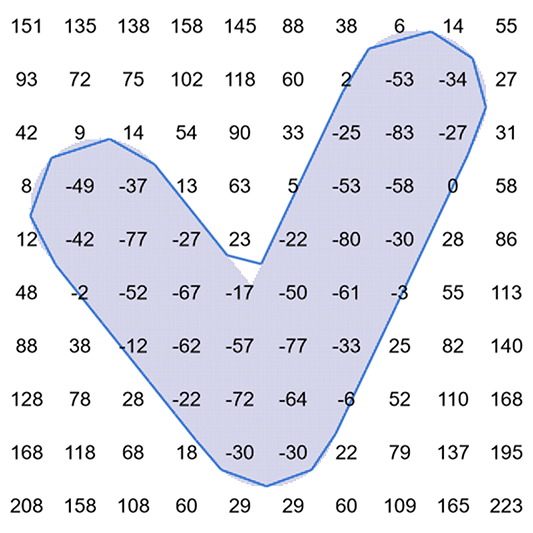
Compare the initial cell-based contour with the gradient- and value-guided fit to see why the direction vector improves placement. section 11.4.1



















