A gradient is a vector of partial derivatives indicating how a function changes with respect to its parameters. In distributed training, each worker calculates gradients from its data partition and uses them to update model parameters. section 7.3.2 section 1.1.2
Workers can send calculated gradients to parameter servers holding model partitions, allowing training when the model cannot fit on one machine. Asynchronous updates improve parallelism but can use stale parameters, block competing workers, and create communication bottlenecks. section 7.3.2
Distributed gradient updates require decisions about coordination and resource layout:
- Parallel workers shorten training time by processing separate data partitions without waiting for one another. section 1.1.2
- Concurrent updates create trade-offs involving completion time, data quality, model quality, and computational efficiency. section 1.1.2
- Parameter-server deployments must balance worker count against parameter-server count to avoid communication bottlenecks. section 7.3.2
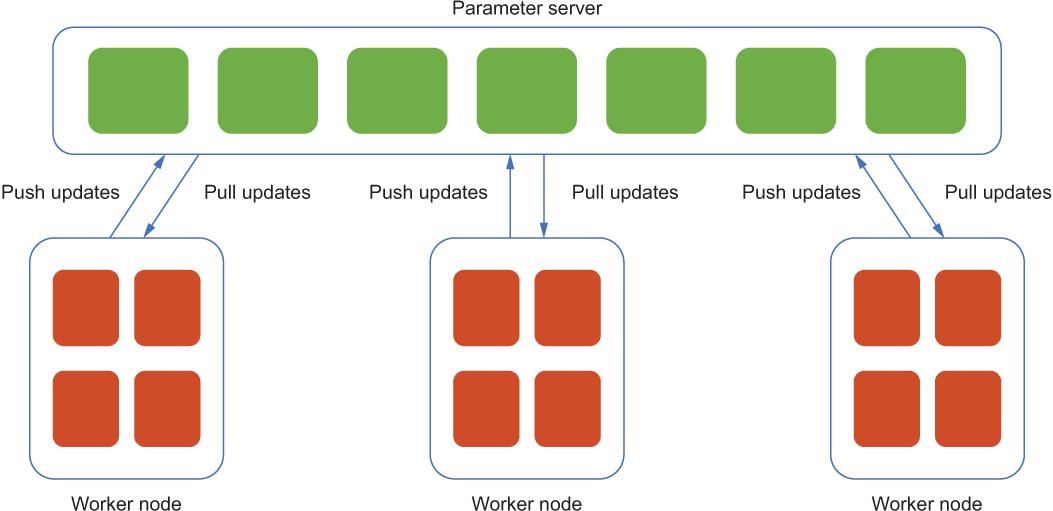
Shows workers sending calculated gradients to model partitions stored across multiple parameter servers. section 7.3.2
Figure 7.10 Distributed model training component with only worker nodes, where every worker stores a copy of the entire set of model parameters and consumes partitions of data to calculate the gradients
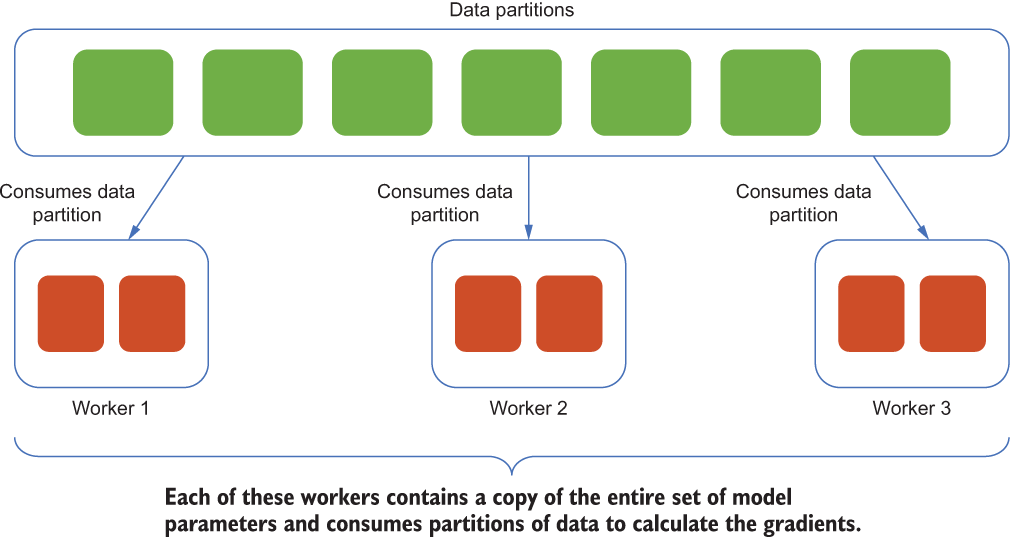
Shows the alternative worker-only arrangement, where every worker stores the full model and calculates gradients from a data partition. section 7.3.2



















