Availability describes whether a service or endpoint can respond when required. A synchronous dependency reduces endpoint availability when the endpoint must wait for every participating service. section 4.4.1 section 12.2.4
For a chain of required services, endpoint availability is the product of their individual availability. Tight runtime coupling also adds their response times, so longer chains can reduce both availability and latency performance. section 4.4.1
Order request
When Order Service waits for Customer Service to validate a customer and reserve credit, both must be available for POST /orders to succeed. At 99.9% availability each, the endpoint is 99.8% available. section 4.4.1
API Composition adds availability risk because a query calls the composer and multiple provider services. Circuit Breaker and Fallback patterns can help the composer fail fast or return replacement data when a provider is unavailable. section 12.2.4
Figure 4.12 The Order Service cannot respond to the POST /orders request until the Customer Service has responded to the PUT /customers/{id} request. As a result, the availability of the POST /orders request is the product of the availability of the Order Service and the Customer Service
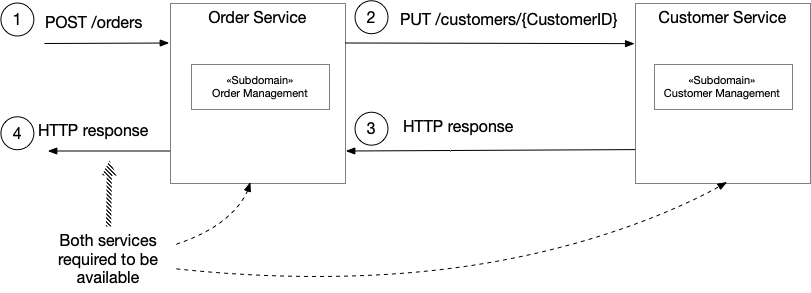
Shows how the Customer Service dependency makes the Order Service wait and affects endpoint availability. section 4.4.1
























