Human-in-the-loop (HITL) puts a person into an agent’s task execution to provide input or oversight. It is useful when an agent cannot resolve ambiguity on its own, when an incorrect result is costly, or when an early error could cascade into later steps. section 1.4 section 8.0
Figure 1.9 An LLM agent processing loop with access to human operators. The processing loop is effectively paused each time a human operator is required to provide input.
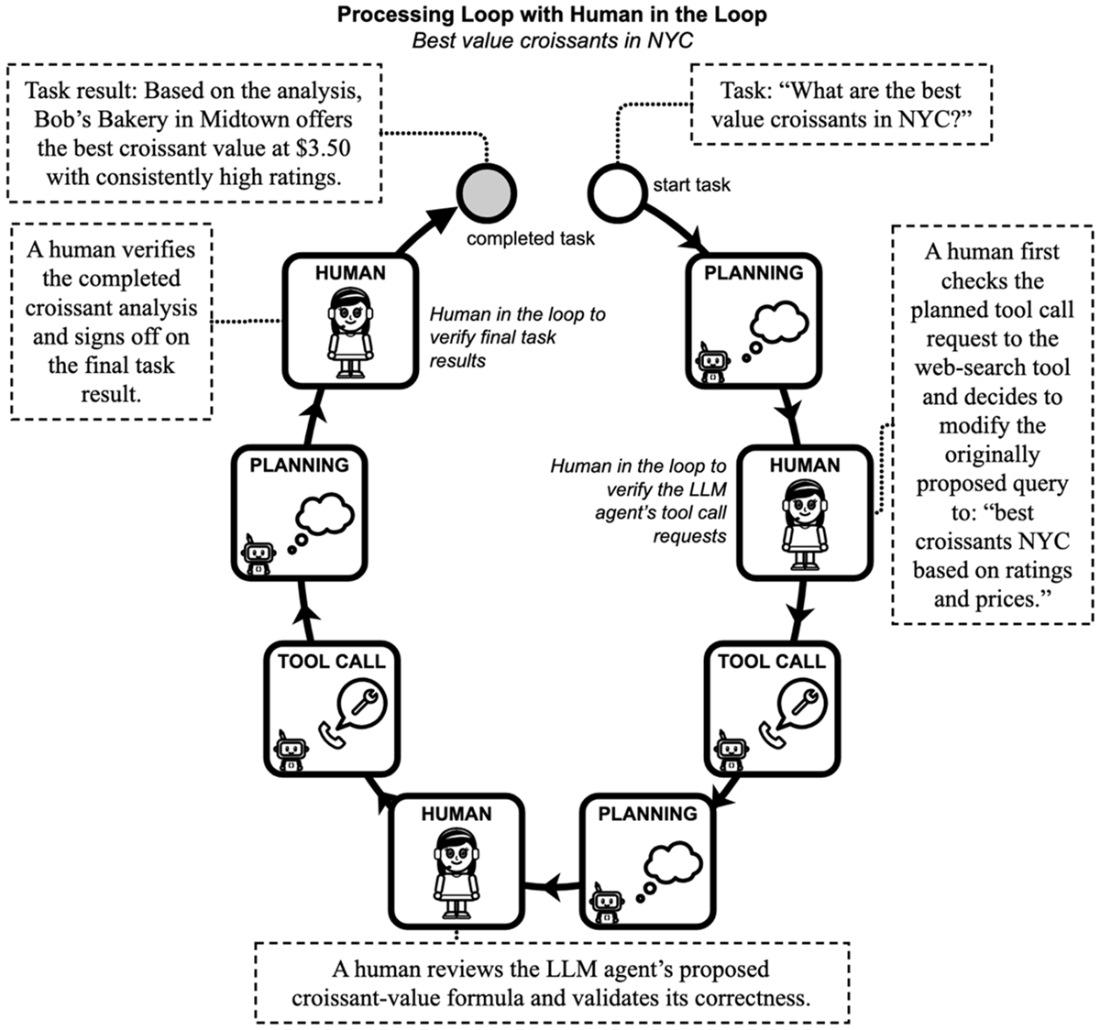
The agent’s processing loop pauses when it needs input from a human operator. section 1.4
Choose an intervention point based on the task:
- Tool-based HITL: Equip the agent with HumanInputTool. The agent decides when to call it, such as when it needs a person’s cuisine preference to narrow restaurant options. section 8.0
- Result-approval HITL: Add an approval gate after execution. The operator accepts the result or rejects it with written feedback, which returns to the processing loop for revision. section 8.0 section 8.1
- Supervised-execution HITL: Use SupervisedTaskHandler for stepwise execution. The operator can inspect and correct a step’s result before triggering the next step. section 8.0 section 8.1
Reviewing a critical bug-fix plan
An agent proposes a plan for shipping a critical fix. A human developer reviews it, accepts it or rejects it with feedback, and lets the agent revise a rejected plan. If errors during execution could have serious downstream effects, the developer can also supervise individual steps. section 8.1
Tool-based input is invoked at the agent’s discretion; approval and supervision are at the operator’s discretion. Approval is lighter weight than stepwise supervision and fits tasks where an occasional wrong result can be caught at the end. Supervision provides more visibility and can help develop or debug an agent. section 8.1
In a multi-agent system, agents can use HumanInputTool, but a single-terminal, single-process implementation needs locking and synchronization for safe requests. Approval can apply to individual tasks or the final aggregated result, depending on where oversight is needed. Simultaneously supervising every agent’s loop is impractical; in a hierarchy, a human can instead oversee the coordinator’s execution. section 8.5