A hidden layer sits between a neural network’s input and output layers. Its nodes transform incoming information into increasingly useful or complex patterns. section 10.8
A fully connected network can organize hidden layers as follows:
- Connect every node in one layer to every non-bias node in the next layer. section 10.8
- Use successive layers to combine simpler classifier boundaries into more complex ones. section 10.8
- Control overfitting with dropout applied between hidden layers during training. section 10.13
A two-hidden-layer classifier
For a circular two-dimensional dataset, a Keras model uses an input layer of size 2, hidden layers of 128 and 64 nodes with ReLU activations, and a two-node softmax output. Dropout with probability 0.2 separates the hidden layers. section 10.18
A regression network
A housing-price model uses hidden layers of 128 and 64 ReLU nodes, each followed by dropout, before producing one numerical output. section 10.20
Figure 10.14 The general architecture of a neural network. The nodes are divided into layers, where the leftmost layer is the input layer, the rightmost layer is the output layer, and all the layers in between are hidden layers. All the nodes in a layer are connected to all the (non-bias) nodes in the next layer.
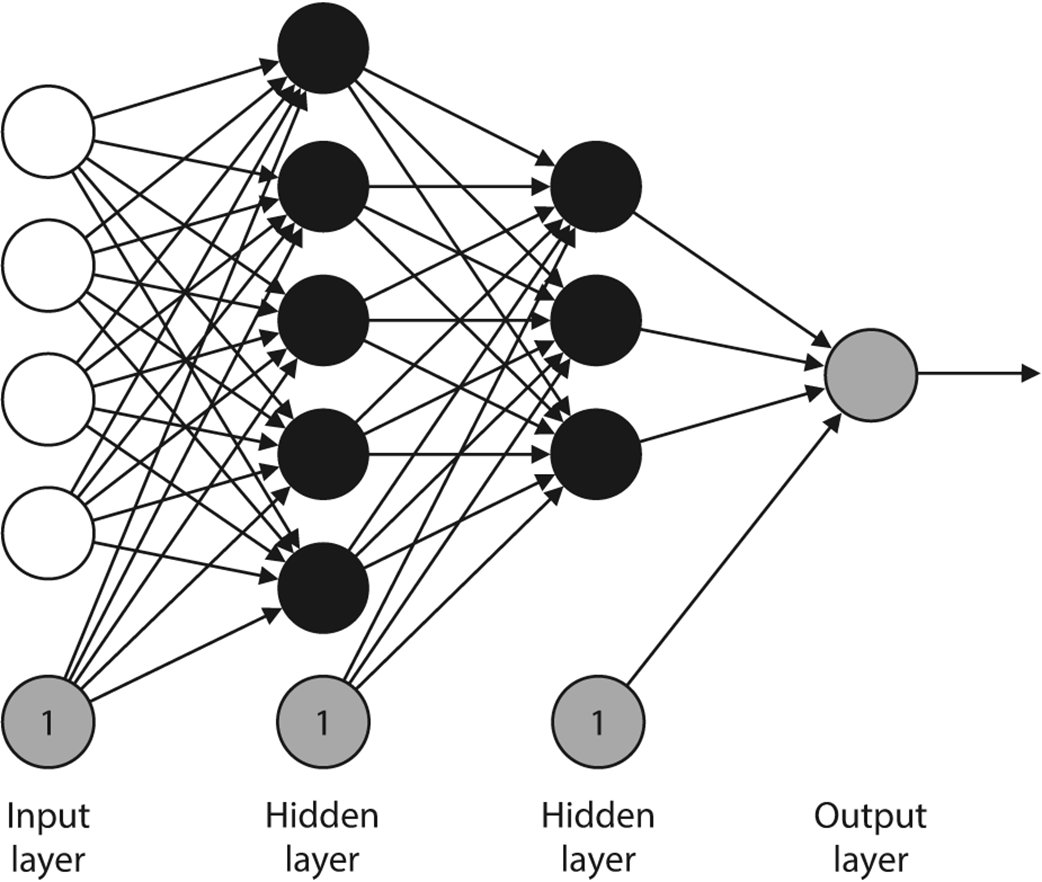
Use the architecture diagram to see how input, hidden, and output layers are arranged and connected. section 10.8










