A key performance indicator (KPI) is a quantitative target that connects an initiative to a defined business, operational, or product objective. In AI work, KPIs turn broad promises such as better personalization or lower costs into outcomes teams can evaluate, communicate, and improve. section 2.1.4 section 12.2.1
Use KPIs to keep AI initiatives focused and credible:
- Tie each metric to a bottleneck, repetitive task, customer outcome, or strategic goal rather than measuring AI activity for its own sake. section 2.1.4 section 12.2.1
- State the target explicitly so teams can assess effects and iterate; a personalized-recommendation click-through rate of 60% is more actionable than “improve personalization.” section 2.1.4
- Translate the KPI into stakeholder language by showing its expected effect on revenue, efficiency, retention, costs, or ROI. section 12.2.1
- Balance expected gains against implementation cost, security, compliance, and adoption; a high metric with marginal business value is not a successful initiative. section 2.1.4
Inventory optimization
An inventory-optimization feature can use a 15% reduction in inventory waste as an operational KPI. Its broader business case projects adoption by 20% of top-tier clients, a $50,000 average upsell, and $2 million in additional annual recurring revenue, assuming an on-schedule launch. section 12.2.1
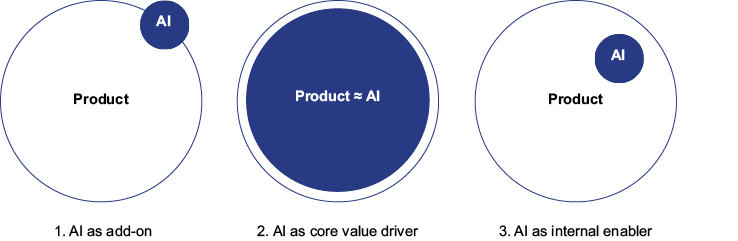
Use the scenario map to compare how KPIs guide customer-facing AI features, internal workflow improvements, and other AI integration choices. section 2.1.4





