Labeled data contains a designated feature, or label, that a model is intended to predict. A label might be a pet’s type, weight, health state, or an email’s spam status. Whether a feature counts as a label depends on the question being asked. section 2.1 section 2.5
Common label types include:
- Numerical labels, such as prices, sizes, ages, or weights, support regression models. section 2.2
- Categorical labels, such as dog/cat or spam/ham, support classification models. section 2.2
- Unlabeled data has no selected feature to predict, although the same dataset could become labeled for a different problem. section 2.1
Pet and email datasets
A pet dataset containing images plus dog/cat tags is labeled; one containing images plus weights is also labeled. An image-only dataset is unlabeled. Similarly, an email table becomes labeled when it includes a spam/ham column. section 2.1 section 2.2
Figure 2.1 Labeled data is data that comes with a tag, or label. That label can be a type or a number. Unlabeled data is data that comes with no tag. The dataset on the left is labeled, and the label is the type of pet (dog/cat). The dataset in the middle is also labeled, and the label is the weight of the pet (in pounds). The dataset on the right is unlabeled.
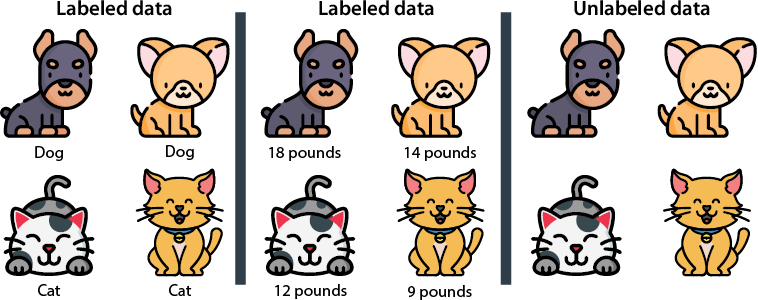
Compare categorical pet labels, numerical weight labels, and an image-only dataset without a target label. section 2.1





