Labeled data pairs examples with target labels or annotations so supervised models can learn the relationship between inputs and desired outputs. In natural language processing, those examples might pair user statements with chatbot responses or documents with sentiment scores. The dataset’s quality strongly influences the resulting system, making careful labeling a practical part of model development rather than clerical preparation. section 1.10 section 2.6
Common forms of labels include:
- Sentiment scores attached to product reviews, using star ratings as numerical measures of positivity. section 2.6
- Hashtags such as #awesome, #happy, or #sarcasm used to create a self-labeled collection of social-media text. section 2.6
- Intent labels attached to chatbot utterances, including newly observed answers that should be recognized as correct. section 12.6
Improving a chatbot with new utterances
Suppose a student gives a valid answer that the chatbot grades incorrectly. Add that utterance to the collection of possible correct answers, assign the appropriate intent, and retrain or improve the natural-language-understanding model. User message logs can reveal which additional examples or intents deserve attention, making labeling an iterative process. section 12.6
Figure 12.6 Conversation design workflow
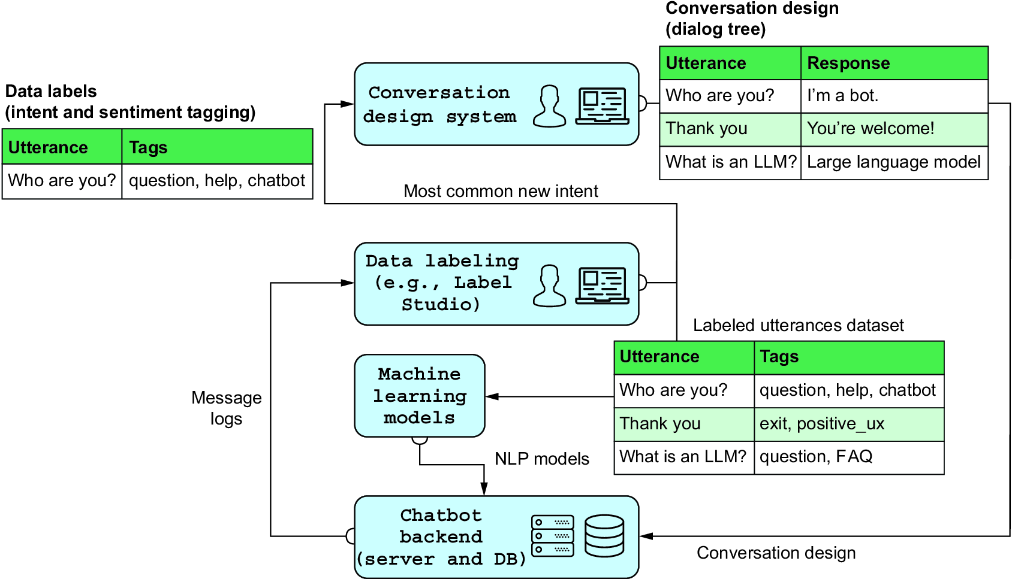
Follow the workflow from conversation design and utterance labeling through model training, deployment, message logging, and data-informed revision. section 12.6





