liveBook · Manning

Learning rate

As explained in Data Without Labels

A learning rate is a scalar hyperparameter that controls the size of parameter updates during iterative training.

A learning rate is a scalar that sets the size of corrective weight updates during training. Larger values can reduce accuracy, while smaller values increase training time. section 8.2.6

Use the learning rate to reason about training behavior:

  • Higher learning rates take larger corrective steps but may produce lower accuracy. section 8.2.6
  • Very low learning rates make training take longer. section 8.2.6
  • Weight updates adjust parameters with respect to loss gradients. section 8.2.6

Boltzmann learning

In a Boltzmann network, the learning rate scales weight corrections based on the difference between visible–hidden co-activation in the data distribution and the model distribution. section 8.8.1

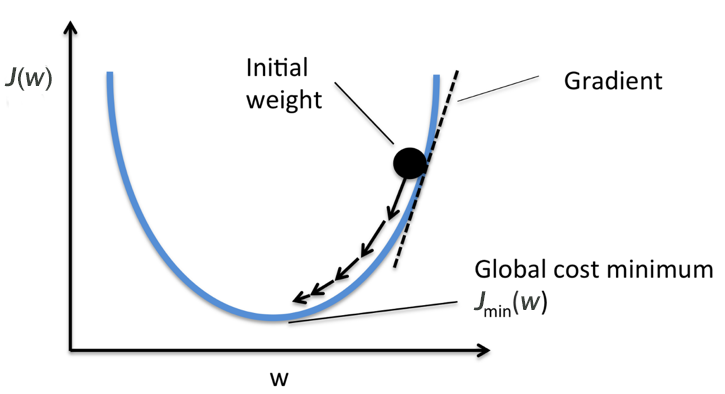
Figure 8.8 The concept of gradient descent. It is the mechanism to minimize the loss function.
figure

Use the gradient-descent figure to visualize how update steps minimize the loss function. section 8.2.6


How Data Without Labels covers it

How deep it goes
Defines update size and training tradeoffs, then applies the parameter to a Boltzmann weight-update rule.
Examples
Illustrates corrective network steps and visible–hidden correlation differences in Boltzmann weight updates.
What you can do after
Evaluate how update size affects accuracy and training time in gradient-based neural-network training.
How it connects
Connects learning rate to gradient descent, loss gradients, momentum, NAG, and Boltzmann learning rules.

Also explained in

Compare how 16 books explain learning rate →

Related concepts

This explainer was generated by Manning's knowledge graph from the text of Data Without Labels. The section links point to the parts of the book it draws on.












