liveBook · Manning

Learning rate

As explained in Evolutionary Deep Learning: Genetic algorithms and neural networks

A learning rate is the step-size parameter that determines how strongly model parameters are updated during training.

A learning rate is a hyperparameter that sets the step size for updating model parameters during training. Tuning it helps balance training speed against the quality of the resulting model. section 5.1.1

Tune the learning rate alongside other training settings:

  • Set it explicitly in the training configuration, such as learning_rate = 3.5e-03, together with epochs, network size, batch size, and data step. section 5.1.1
  • Change the value substantially, rerun training, and compare the resulting plots; one experiment changes 3.5e-06 to 3.5e-01. section 5.1.1
  • Treat the setting as model- and optimizer-dependent: GAN exercises vary the generator and discriminator optimizer rates separately. section 9.1.3
  • Inspect its effect on agent learning by changing learning_rate in an evolutionary reinforcement-learning configuration. section 11.1.2

Compare learning-rate settings

Run the same notebook configuration for 500 epochs, changing only learning_rate, then compare the training plots. Repeat the experiment independently for the generator and discriminator optimizers in a GAN. section 5.1.1 section 9.1.3
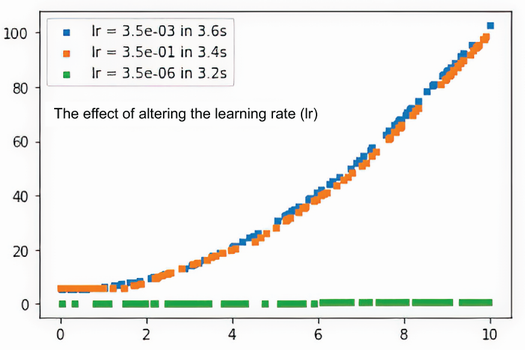
Figure 5.4 The effects of altering the learning rate

Inspect the figure comparing the effects of altering the learning rate. section 5.1.1

How Evolutionary Deep Learning: Genetic algorithms and neural networks covers it

How deep it goes
Demonstrates configuration and comparative reruns, emphasizing observed training effects rather than update-equation derivations.
Examples
Uses notebook values from 3.5e-06 to 3.5e-01, GAN generator and discriminator settings, and agent-learning exercises.
What it assumes
Assumes basic notebook execution and familiarity with configurable training hyperparameters.
What you can do after
Diagnose training behavior by changing learning-rate settings and observing effects on models, GANs, or agents.
How it connects
Connects hyperparameter optimization with batch size, optimizers, GAN training, reinforcement learning, and evolutionary optimization.

Also explained in

Compare how 16 books explain learning rate →

Related concepts

This explainer was generated by Manning's knowledge graph from the text of Evolutionary Deep Learning: Genetic algorithms and neural networks. The section links point to the parts of the book it draws on.













