A learning rate controls the step size used to update model parameters during optimization. After backpropagation calculates gradients, an optimization algorithm such as stochastic gradient descent uses those gradients and the learning rate to update weights and biases. section 3.2.1
Treat the learning rate as an operational training setting:
- It influences how quickly training progresses and affects the model’s eventual prediction accuracy. section 5.1.2
- Evaluate it within the complete training loop: prediction, loss calculation, backpropagation, parameter update, and model saving. section 3.2.1
- Tune it alongside batch size, regularization, activation functions, layer count, and neuron count rather than treating it as an isolated choice. section 5.1.2
Experimenting with a spiral classifier
In TensorFlow Playground, vary the learning rate while configuring a six-layer network with five neurons per layer, ReLU activation, batch size 10, and L1 regularization. Compare training time, learning curves, and classification performance after roughly 500 epochs. section 5.1.2
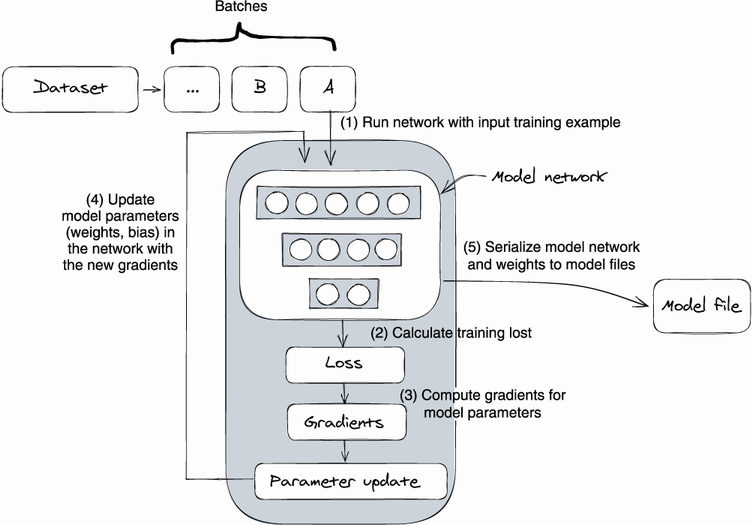
Use the training-workflow figure to locate the learning rate at the parameter-update stage, after gradients are calculated. section 3.2.1















