In an agentic interaction, a constraint turns an open-ended request into a bounded action surface. It limits what the agent may do, which context and evidence it may use, and when it must clarify, reject, escalate, or hand control to a person. section 6.2.2 section 6.2.1
A constraint works with intent, context, authority, expected outcome, and evidence obligation. Together, these elements define why an interaction exists, how it is interpreted, what action is permitted, what completion means, and what record must remain. section 6.2.2
Apply constraints at explicit enterprise decision boundaries:
- Restrict permitted intents rather than merely naming an API operation; “assess whether lot 2418 requires containment” carries more governance than “query production history.” section 6.2.2
- Limit actions through delegated authority, required context, runtime policy checks, and an approved operating envelope. section 6.2.2 section 6.2.1
- Define denial, clarification, escalation, and human-handoff paths when the request exceeds the agent’s authority or lacks sufficient context. section 6.2.1
- Preserve the contract instance and evidence obligation across APIs, tools, events, workflows, and agent-to-agent exchanges. section 6.2.1
Quality investigation
Elena asks a supervisor agent to assess whether a production lot requires containment. The constraint boundary identifies the affected lot, required production and supplier evidence, permitted recommendations, delegated authority, and the point where Elena, supplier quality, or regulatory affairs must take control. section 6.2.2 section 6.2.1
Figure 6.2 Anatomy of a conversational contract. A conversational contract carries an agentic interaction from intent toward outcome. Context shapes how the intent is interpreted, constraints and authority define the boundary within which the agent may act, and the evidence obligation defines what must remain after the agent has acted.
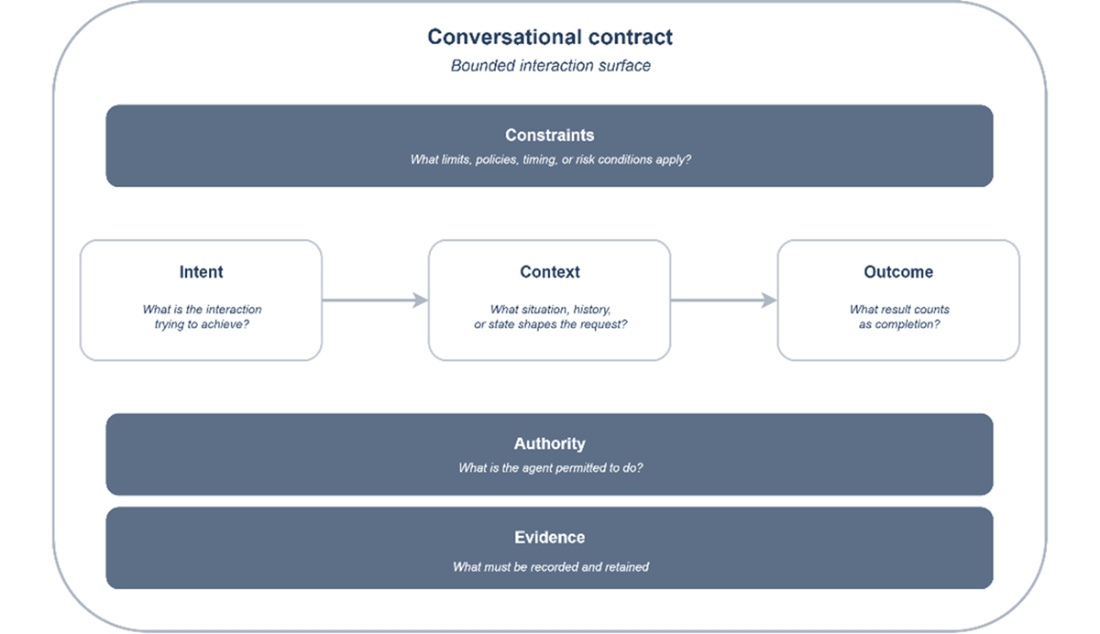
Use the contract anatomy to trace how constraints and authority bound movement from intent toward outcome while evidence remains after action. section 6.2.2
Table 6.2 Conversation-as-Interface pattern card
|
Attribute
|
Definition & Requirements
|
|
Mandate
|
Treat the agentic interaction as a governed contract
surface through which intent, context, constraints, authority, outcome, and
evidence obligations are made explicit before the agent invokes tools,
exchanges work with other agents, publishes events, or hands control to a
human.
|
|
Scope
|
Applies where an autonomous or semi-autonomous agent
interacts with a person, enterprise system, tool, resource, workflow, event
stream, or another agent under delegated authority.
|
|
Operating envelope
|
Valid when the interaction can be bounded by an explicit
conversational contract that defines permitted intents, required context,
runtime constraints, authority checks, expected outcomes, evidence
obligations, and escalation or denial paths.
|
|
Boundary of authority
|
The agent may act only within the intents, constraints, and
authority granted by the conversational contract, and only through the
interaction types the contract permits. Actions outside the contract must be
rejected, mediated through a governed tool wrapper, routed through an
approved agent-collaboration path, or escalated to a human or a supervisory
agent.
|
|
Failure mode
|
If intent is ambiguous, context is incomplete, authority
is insufficient, the requested outcome exceeds the contract, or the
interaction type is not permitted, the interaction must fail closed through
clarification, rejection, escalation, or handoff rather than continue through
implicit interpretation.
|
|
Evidence & auditability
|
The interaction must leave a record of the expressed
intent, relevant context, constraints applied, authority basis, interaction
mechanism used, outcome requested, actions taken, and any escalation, denial,
or handoff path triggered.
|
Use the pattern card to inspect the required operating envelope, authority boundary, evidence obligations, and escalation paths for a governed interaction. section 6.2.1




























