An MCP client connects an application to one or more MCP servers. It discovers and invokes server-exposed tools, prompts, and resources, then passes structured results back to the application. The client handles protocol communication; an AI agent handles decisions about whether to use a capability. section 12.2 section 12.4
In a Next.js chat integration, the request follows this path:
- A React chat interface sends the user’s message to an API route. section 12.3.2
- The route starts a local MCP server through a stdio transport, creates a client, and retrieves the server’s tools. section 12.3.2
- The model or agent receives those tools and can invoke one. The server executes the external request and returns a result for the chat response. section 12.3.2 section 12.5.2
Connect from a Next.js API route
With the Vercel AI SDK, create a stdio transport for the Node.js server, then discover its tools: const transport = new StdioClientTransport({ command: 'node', args: ['src/stdio/server.js'], }); const mcpClient = await experimental_createMCPClient({ transport }); const tools = await mcpClient.tools(); Pass `tools` into `streamText` with the chat messages and model. A `useChat` frontend can send messages to the route and render the streamed response. Close the client when the response finishes or an error occurs. section 12.3.2
For a LangChain.js agent, `MultiServerMCPClient` is an alternative: configure a stdio server, call `getTools()`, and give the tools to a LangChain agent alongside the Gemini model. The API route invokes the agent, closes the client, and streams the output to the UI. Keep external-API error handling in the MCP server so failures produce predictable responses. section 12.5.2 section 12.8
Figure 12.3 How the Vercel AI SDK communicates with a local MCP server through stdio transport. The MCP client spawns the server as a separate Node.js process, and they exchange JSON-RPC messages via stdin/stdout. When the model calls a tool like get-chuck-joke(), the request flows through stdio to the MCP server, which executes the actual HTTP request and returns the response.
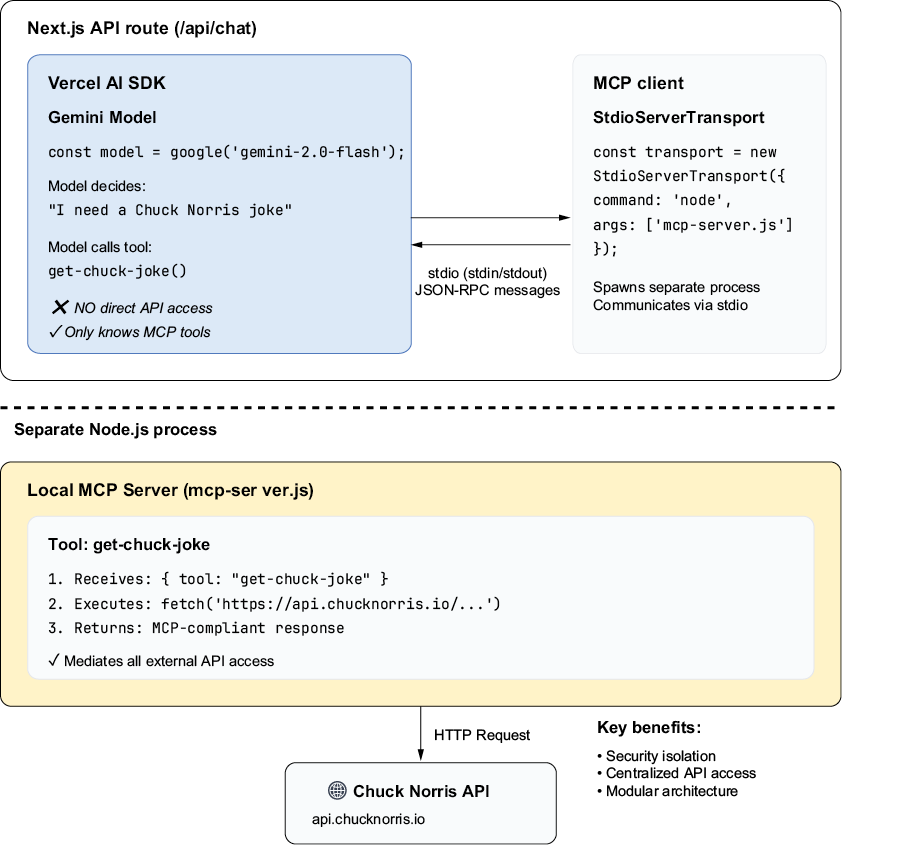
Trace how a local client exchanges requests and results with a separate server process over stdio. section 12.3.2







