A multi-agent system combines specialized agent profiles that communicate and coordinate to solve a problem. A controller or proxy can direct workers such as a coder and tester, which produce and evaluate results together. section 1.1
Common coordination patterns include:
- Proxy communication: a user proxy receives human direction, delegates work to assistant agents, reviews results, and supplies feedback until completion. section 4.1
- Group chat: multiple agents share information, ask questions, and provide updates while collaborating on a complex task. section 4.6
- Role-based workflows: agents such as data fetchers, analyzers, and presenters execute sequential or hierarchical tasks. section 4.6
A code-writing workflow with AutoGen
Install pyautogen, configure an OpenAI- or Azure-compatible model, and create a ConversableAgent with a UserProxyAgent. Ask the proxy to have the assistant write a one-line FizzBuzz solution. The proxy can execute the generated code, inspect the result, request corrections, and terminate when the response ends with TERMINATE. Similar tasks include a prime-number function or a Pygame game. section 4.2.1
Figure 1.2 In this example of a multi-agent system, the controller or agent proxy communicates directly with the user. Two agents—a coder and a tester—work in the background to create code and write unit tests to test the code.
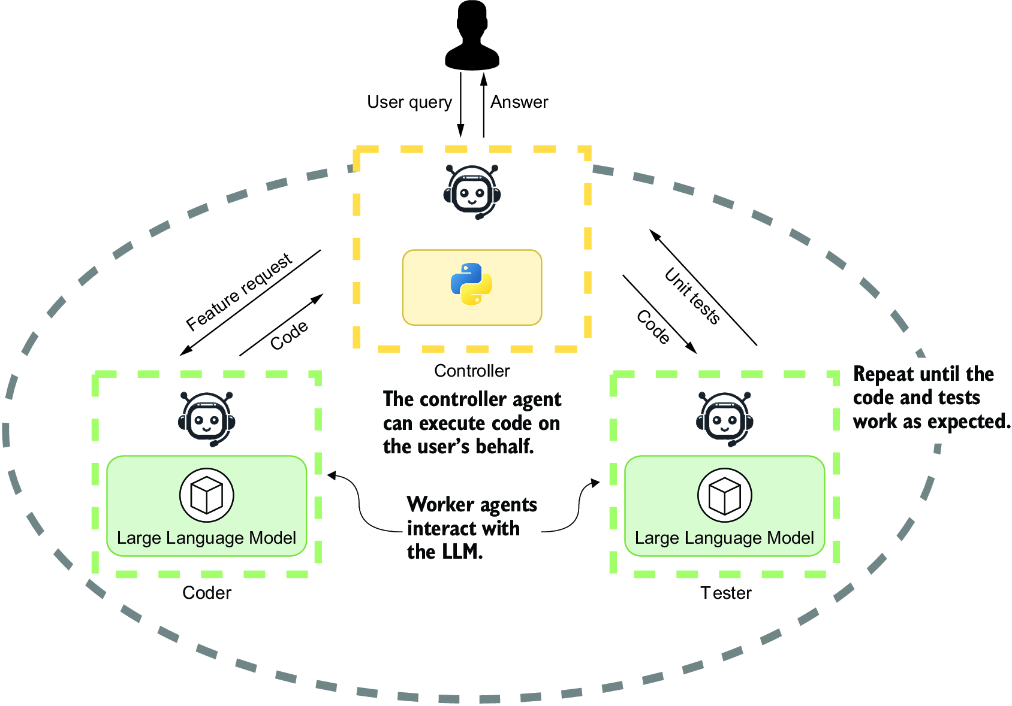
Shows a controller or agent proxy communicating with the user while coder and tester agents work in the background. section 1.1








