A multi-agent system divides a task among agents with specialized roles. It becomes useful when one agent’s growing system prompt and tool set make relevant instructions harder to find and tool choices less reliable. Each specialist can keep a focused prompt and only the tools it needs. section 9.1 section 9.0
Technical blog writing
Split the work among agents for research, coding, drafting, and review. Give the research agent search tools and the coding agent code-execution tools, rather than giving every agent every instruction and tool. section 9.1
Figure 9.2 Four specialist agents for technical blog writing. Each agent focuses on a single role with optimized prompts and dedicated tools.
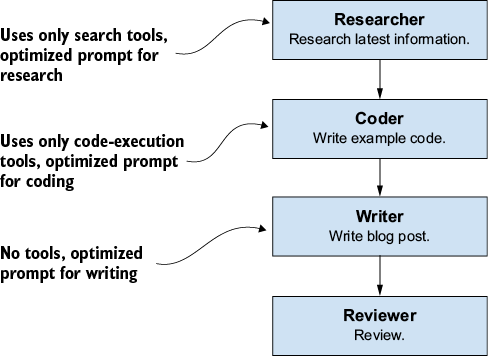
The four-role diagram shows how a single writing task can be divided into specialists with focused prompts and dedicated tools. section 9.1
Specialization alone does not determine how work moves between agents. Choose a collaboration pattern by asking who selects the next agent—the developer or the LLM—and whether agents share context. section 9.7
Three patterns provide different control and context behavior:
- Workflow: the developer sets execution order in code. Sequential passes context onward; Parallel runs agents concurrently and merges results; Loop repeats until a stop condition. section 9.7
- Agent as Tool: an orchestrator calls a specialist through AgentTool and receives its final result, while the specialist’s intermediate work remains isolated. section 9.7
- Transfer: the LLM calls a transfer_to_agent tool to hand over control. The receiving agent shares context and continues the conversation. section 9.7
These patterns can be combined: use a workflow for overall structure, tool-wrapped agents for specialist consultation, and transfers for routing. A2A extends collaboration across network boundaries; RemoteAgent gives clients the same interface for remote and local agents. section 9.7








