An employee needs onboarding. Instead of asking one AI agent to handle everything, an intake agent can pass parts of the request to agents responsible for human resources, IT setup, and facilities. A multi-agent system coordinates such specialized agents toward a shared goal. Each may have its own role, memory, or access to tools; the agents communicate, delegate, and synchronize their work. section 8.9
Figure 8.4 Coordinated multi-agent workflow with specialized agents handling distinct subtasks
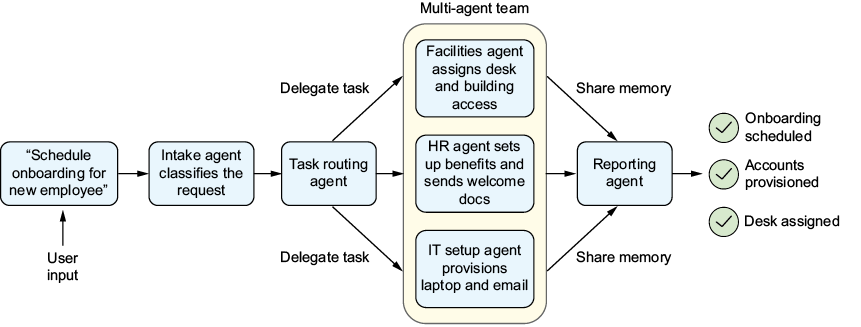
The workflow diagram shows how specialized agents handle distinct subtasks within one coordinated process. section 8.9
This division of labor can make a complex task more modular than assigning it to one general-purpose agent. Orchestration frameworks let developers configure roles, tool access, memory, and handoffs. Some multi-agent systems have outperformed single-agent approaches on tasks needing modular reasoning or parallel work, but that advantage is not universal. Most remain under human supervision, particularly in enterprise and safety-critical settings. section 8.26 section 8.9
Coordinated research
AgentLab assigns agents roles such as literature reviewer, experiment designer, coder, and manuscript drafter within a research workflow. In drug discovery, Google’s AI Co-Scientist uses collaborating agents to propose, evaluate, and refine candidate molecules while experts retain control over selection and approval. section 8.5
Coordination also creates risks that cannot be found by checking each agent alone. Agents may reinforce a mistaken answer, settle too quickly on flawed consensus, or pass one error through a workflow. Interactions can produce unexpected group behavior, including cooperation but also cascading failures. Poorly specified goals and excessive delegation can make the consequences more serious. section 8.21 section 10.11
Evaluation therefore needs to follow actions and interactions over time, not just inspect a single response. Red teams can probe for miscoordination, collusion, unsafe tool use, and cascading failures. Findings can inform safeguards, but testing alone does not prevent harm. section 10.22








