Multifactor authentication verifies identity using two or more distinct types of authentication factors.
Multifactor authentication verifies identity using two or more distinct factor types. For cloud sign-in, a password paired with a time-based hardware token is one example; it is recommended over password-only credentials. section 4.1.3
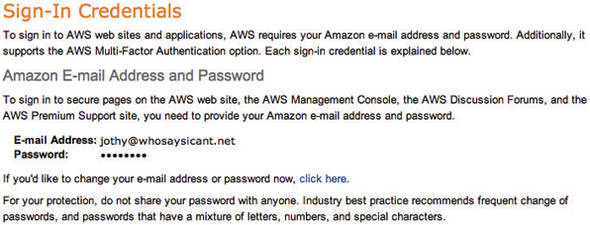
Figure 4.4. The AWS step of providing sign-in credentials. In this case, it’s single-factor, password-based. But multifactor authentication is highly recommended, such as using a time-based hardware token (something you have) in addition to a password (something you know).
Compare password-only sign-in with a password and hardware token. section 4.1.3
How The Cloud at Your Service: The when, how, and why of enterprise cloud computing covers it
How deep it goes
Recommends MFA and contrasts it with password-only sign-in, but does not detail factor enrollment or recovery.
Examples
Pairs a password with a time-based hardware token such as RSA SecurID.
What you can do after
Evaluate sign-in choices by recognizing MFA as stronger than password-only authentication.
How it connects
Links authentication to passwords, hardware tokens, identity verification, and cloud access control.
ASP.NET Core in Action, 3eMultifactor authentication is authentication that requires evidence from multiple independent credential or verification factors.
Microsoft Azure in ActionMulti-factor authentication (MFA) is an authentication technique that requires two or more independent types of evidence to verify an identity.
Grokking Web Application SecurityMultifactor authentication is an authentication technique that requires a user to provide at least two distinct forms of identification.
authentication factoruses · An authentication factor is a distinct category of evidence used to verify a subject’s identity during authentication.
Microsoft Entra IDused by · Microsoft Entra ID is Microsoft's cloud-based identity and access-management service for authenticating users, applications, and services and controlling their access to resources.
access controluses · Access control is the set of measures that determine who may access computing resources and what actions they may perform.
conditional accessconfigured by · Conditional access is an access-control technique that grants or denies requests according to contextual conditions and policy requirements.
IAM userused by · An IAM user is an AWS identity representing a person or application with credentials and assigned permissions within an account.
This explainer was generated by Manning's knowledge graph from the text of The Cloud at Your Service: The when, how, and why of enterprise cloud computing. The section links point to the parts of the book it draws on.