Natural language processing (NLP) is the field where computer science and linguistics meet to develop technology that helps computers understand, manipulate, and create human language. Its history reaches back to 1940s efforts to automate translation. Modern language models belong to NLP, but their larger scale and much greater training data distinguish them from many earlier systems. section 1.1
NLP provides techniques used by large language models (LLMs), which are machine-learning models trained on large amounts of linguistic data. ChatGPT and similar tools use LLMs to accept and generate text, although fluent output does not by itself establish what the system understands. section 1.1
Figure 1.3 A high-level map of the various terms you’ll become familiar with and how they relate. Generative AI is a description of functionality: the function of generating content and using tech- niques from AI to accomplish that goal.
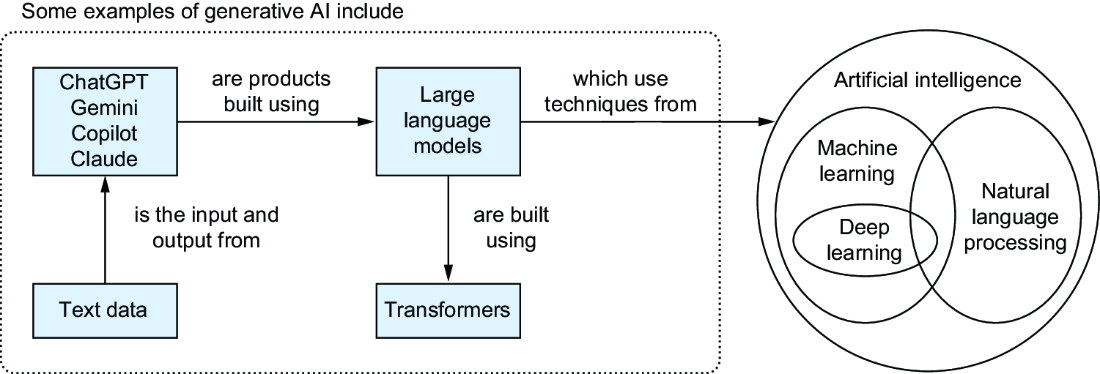
Maps NLP, AI, generative AI, LLMs, and related tools in one high-level diagram. section 1.1














